Chapter 15 Geometry: Kūmau (North Star)
Navigators determine latitude using Kūmau (also known as Hōkūpaʻa or the North Star). Through a geometric lens, students investigate how the star’s position corresponds to one’s location on Earth. This unit develops understanding of congruence through rigid transformations, connecting celestial observation to geographic positioning.
Section 15.1 Student Learning Objectives
By the end of this lesson, students will be able to:
-
Define latitude in geometric terms using angles and planes.
-
Explain why the altitude of Kūmau above the horizon equals the observer’s latitude.
-
Use triangle geometry (angle sums and perpendicular lines) to model celestial navigation.
Section 15.2 Student Learning Outcomes
Students will demonstrate their learning by
-
Constructing and labeling a geometric diagram showing latitude, the horizon, and Kūmau.
-
Explaining in writing why the angle from the horizon to Kūmau equals latitude.
-
Applying triangle congruence and angle relationships in solving related geometry problems.
-
Comparing geographic latitudes of different places (e.g., Hawaiʻi vs. Rarotonga) using angular reasoning.
Section 15.3 Core Standards
-
CCSS.MATH.CONTENT.HSG.CO.A.1: Know precise definitions of angle, circle, perpendicular line, parallel line, and line segment, based on the undefined notions of point, line, distance along a line, and distance around a circular arc.
-
CCSS.MATH.CONTENT.HSG.CO.C.9: Prove theorems about lines and angles.
-
CCSS.MATH.CONTENT.HSG.CO.D.12: Make formal geometric constructions with a variety of tools and methods (compass and straightedge, string, reflective devices, paper folding, dynamic geometric software, etc.).
Section 15.4 Introduction
As Earth rotates about its axis, the stars in the sky appear to move from east to west. This constant motion makes it impossible to tell how far you are east or west (longitude). However, the stars can tell us how far north or south you are (latitude). In the Northern Hemisphere, this is done by looking at the angle from the horizon to Kūmau (Hōkūpaʻa, the North Star).
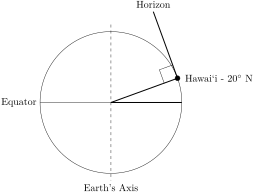
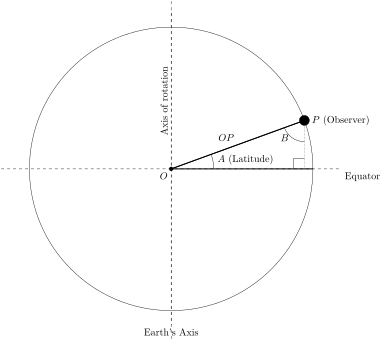
Latitude is the angle formed by a line drawn from an observer on the Earth’s surface to the center of the Earth and the equatorial plane. For example, the equator is at \(0^{\circ}\) latitude, the North Pole is at \(90^{\circ}\) N, and the South Pole is at \(90^{\circ}\) S.
Honolulu, Hawai’i, is at approximately \(21^{\circ}\) N latitude, meaning a line from Honolulu to the center of the Earth forms a \(21^{\circ}\) angle north of the equatorial plane. In the South Pacific, Rarotonga, Cook Islands, is at approximately \(21^{\circ}\) S latitude, meaning a line from Rarotonga to the center of the Earth forms a \(21^{\circ}\) angle south of the equatorial plane.
Kūmau is nearly directly above the North Pole and is so far away that its light rays can be treated as parallel lines. This creates a geometric relationship between the horizon, latitude, and the star’s altitude.
Section 15.5 Geometry Explained
Students will use geometric reasoning to explain why: The angle of Kūmau above the horizon equals the observer’s latitude.
-
Latitude Defined
-
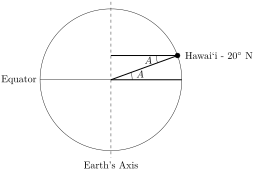
A line from the observer to Earth’s center forms angle \(A\) with the equatorial plane.
-
This angle \(A\) is the observer’s latitude.
Figure 15.1. The latitude of an observer is the angle formed between the observer, the center of the Earth, and the equatorial plane. 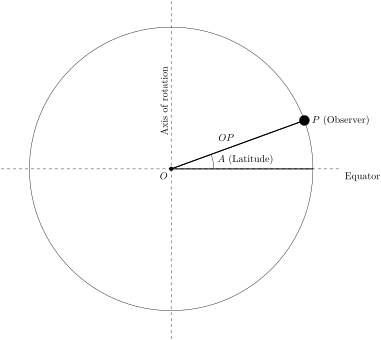
-
-
Parallel Rays from Kūmau
-
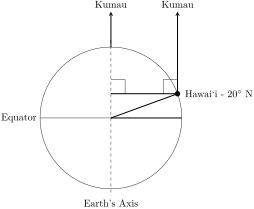
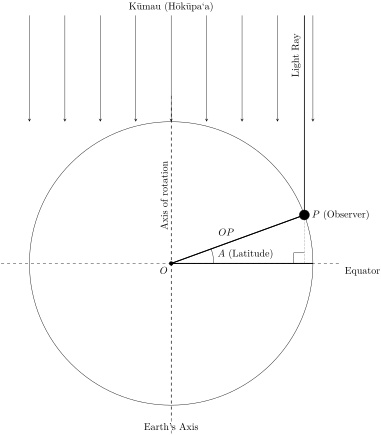
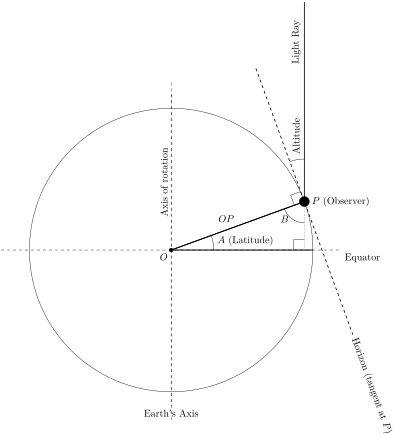
Light rays from Kūmau are nearly parallel to Earth’s axis of rotation.
-
The equatorial plane is perpendicular to that axis, so the light rays are also perpendicular to the equator.
-
-
Right Triangle Formed
-
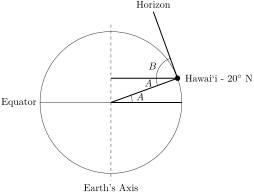
A triangle is created by the line to Earth’s center, the light ray from Kūmau, and the equatorial plane.
-
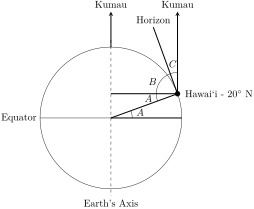
Angles: \(A\) at Earth’s center, \(90^{\circ}\) at the equator, and \(B\) at the observer.
-
The sum of these angles is \(180^{\circ}\text{,}\) so \(A+B+90^{\circ}=180^{\circ}\text{.}\)
-
-
At the Observer
-
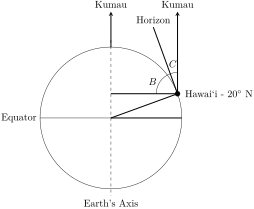
At the observer, three angles meet:
-
\(B\) (between Earth’s center line and Kūmau’s ray).
-
\(90^{\circ}\) (between Earth’s center line and horizon, by definition of horizon).
-
Altitude (angle between horizon and Kūmau).
-
-
These three angles form a straight line, summing to \(180^{\circ}\text{,}\) so: \(B+90^{\circ}+\mbox{Altitude}=180^{\circ}\)
-
-
Equating the Two
-
Since \(A+B+90^{\circ}=B+90^{\circ}+\mbox{Altitude}\) we conclude:
-
\(A=\mbox{Altitude}\text{.}\)
-
Thus, the angle of Kūmau above the horizon equals the observer’s latitude.
Section 15.6 Classroom Activity
-
Diagram Construction
-
Students draw Earth, the equator, a horizon line, and Kūmau’s parallel rays.
-
They mark and label the relevant angles (\(A\text{,}\) \(B\text{,}\) Altitude).
-
-
Worked Example
-
If an observer in Hawaiʻi measures Kūmau \(21^{\circ}\) above the horizon, show geometrically why this means Hawaiʻi is at \(21^{\circ}\) N latitude.
-
Students repeat the construction for Rarotonga (Kūmau not visible, demonstrating negative latitude).
-
-
Hands-On Measurement
-
Use protractors and classroom horizon lines (edge of desk/window) to simulate measuring the altitude of Kūmau.
-
Students use their hands to measure.
-
Section 15.7 Extensions
-
Navigation Practice: Compare latitudes of Pacific islands and discuss how navigators recognized where they were by the altitude of Kūmau.
-
Geometry Connection: Explore congruent triangles formed by the horizon, the line to Earth’s center, and the parallel rays from Kūmau.
-
Challenge: Show why the method does not work in the Southern Hemisphere (Kūmau not visible).
-
Prove that the altitude of Kūmau is the same as the latitude using a different method (e.g. properties of parallel lines with a transverse, alternate interior angles,)
Section 15.8 Exit Ticket
-
Define latitude in your own words.
-
Explain why the angle of Kūmau above the horizon equals your latitude.
-
If Kūmau is \(35^{\circ}\) above the horizon, what is your latitude?
-
Why can’t this method be used south of the equator?
Section 15.9 Alternate Diagrams
Here are alternate diagrams to show that the latitude is the same angle as the altitude to Kūmau.