Chapter 1 Star Compass Construction
In this section we will learn how to construct the Star Compass. This will be broken into five lessons.
Section 1.1 Lesson 1: Locating the Houses of the Star Compass
In this section we will learn how to construct the Star Compass. This will be broken into five lessons.
Subsection 1.1.1 Introduction/Review of the Star Compass (25 mins)
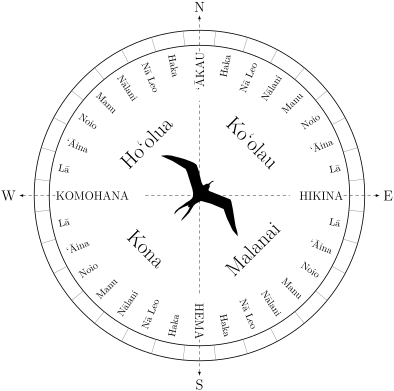
- History
- Use of the Star Compass
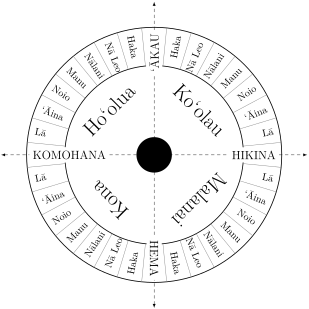
- Location of Houses and Quadrants
Subsection 1.1.2 Discussion on the Physical Properties of the Hawaiian Star Compass (5 mins)
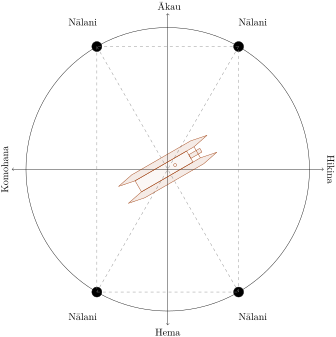
If a star rises in House Nālani Koʻolau, it will travel over the sky and set in the same House Nālani but in the quadrant Hoʻolua (symmetry in math). Similarly, if a wind or current enters a canoe in House Nālani Koʻolau, it will exit the canoe in House Nālani Kona (symmetry). Show this movement from one house, to the center (canoe), and continuing to the same house but different quadrant.
Subsection 1.1.3 Understanding the Relationship between Houses and Degrees on the Star Compass (5 mins)
As we explore the Star Compass, it is important to know the relationship between Houses and their angles.
How many houses are in the Star Compass? Ans: 32 Houses.
How many degrees are in one cifcle? Ans: \(360^{\circ}\)
To find the angle associated with each house, we divide the total number of degrees in a circle (360) by the number of houses on the Star Compass (32):
\begin{equation*}
\mbox{angle per house}=\frac{360^{\circ}}{32}=11.25^{\circ}
\end{equation*}
If you prefer, you can obtain the same answer through halving.
Start with the total degrees in a circle, which is \(360^{\circ}\text{,}\) and the total number of houses in the Star Compass, which is 32.
Halve \(360^{\circ}\) to get \(180^{\circ}\text{.}\)
Halve the number of houses (32) to get 16 houses.
Continue halving:
Halve \(180^{\circ}\) to get \(90^{\circ}\text{.}\)
Halve 16 houses to get 8 houses.
Halve \(90^{\circ}\) to get \(45^{\circ}\text{.}\)
Halve 8 houses to get 4 houses.
Halve \(45^{\circ}\) to get \(22.5^{\circ}\text{.}\)
Halve 4 houses to get 2 houses.
Halve \(22.5^{\circ}\) to get \(11.25^{\circ}\text{.}\)
Each house on the Star Compass is \(11.25^{\circ}\text{.}\)
Subsection 1.1.4 Constructing One Quadrant on the Board (10 mins)
- Draw a blank quadrant Koʻolau on the board and have students follow along on their own papers.
- Label Hikina and ʻĀkau.
We will first construct the quadrant Koʻolau of the Star Compass. On the board, draw a blank quadrant Koʻolau. Label Hikina and ʻĀkau.
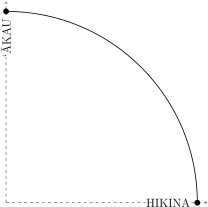
Now, focus on the names of the houses in each quadrant (specifically Koʻolau). Identify the name of the house in the middle (Manu) and the house halfway between Manu and Hikina (ʻĀina).
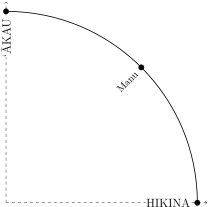
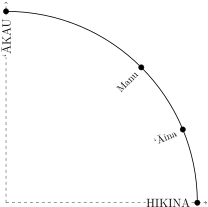
Continue the process of halving to locate all the houses in the quadrant.
- Lā: halfway between ʻĀina and Hikina.
- Noio: halfway between Many and ʻĀina.
- Nā Leo: halfway between Manu and ʻĀkau.
- Nālani: halfway between Manu and Nā Leo.
- Haka: halfway between Nā Leo and ʻĀkau.
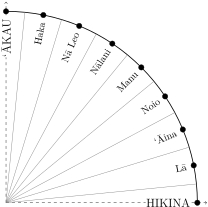
For further practice, have students independently create the quadrant Hoʻolua using the same method.
By completing the construction of one quadrant of the Star Compass, students have gained a solid understanding of the interconnectedness and symmetry within the Hawaiian Star Compass. They can now comfortably locate houses by finding the midpoint between two other houses. This hands-on activity not only reinforces mathematical concepts but also provides a tangible connection to the cultural and navigational significance of the Star Compass
Subsection 1.1.5 Angles on the Star Compass (10 mins)
In this part, we will determine the angle for each house on the Star Compass.
On the board, with students following along on their papers, draw the the Koʻolau quadrant, setting the Baseline Angle: If we assume that Hikina is \(0^{\circ}\text{,}\) what angle would ʻĀkau be? Answer: \(90^{\circ}\)
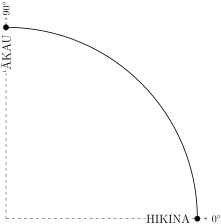
Now, recall when we first constructed the Star Compass, what house was located halfway between Hikina and ʻĀkau? Ans: Manu. If Manu is halfway between \(0^{\circ}\) and \(90^{\circ}\text{,}\) what is the angle for Manu? Ans: \(45^{\circ}\text{.}\)
What house was located halfway between Hikina and Manu? Ans: ʻĀina. If ʻĀina is halfway between \(0^{\circ}\) and \(45^{\circ}\text{,}\) what is the angle for ʻĀina? Ans: \(22.5^{\circ}\)
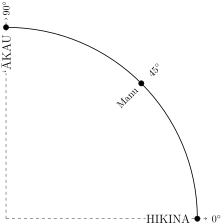
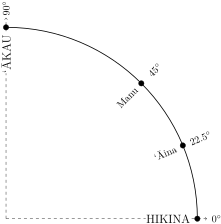
Repeat the Process: Continue applying these steps to determine the angles for all houses in the Koʻolau quadrant.
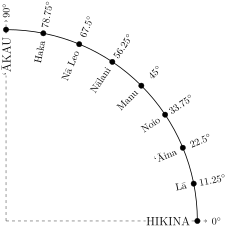
By following this method, students will not only grasp the angles associated with each house but also reinforce their understanding of angular relationships on the Star Compass. This activity covers the topic of dividing integers, providing a practical application of mathematical concepts in a real-world context.
Subsection 1.1.6 Spacing Between Houses (5 mins)
What do you notice about the angles for the houses in the Star Compass? What is the angle between Hikina and Lā? What about between Lā and ʻĀina? Ans: Emphasize that all the spacing between each house is \(11.25^{\circ}\text{.}\)
Where have we seen \(11.25^{\circ}\text{?}\) Ans: This is what we calculated earlier. Each house is \(11.25^{\circ}\text{.}\)
So if we know that Hikina is \(0^{\circ}\) and each house is \(11.25^{\circ}\text{,}\) what would the angle be for Lā? Ans: \(0^{\circ}+11.25^{\circ}=11.25^{\circ}\text{.}\)
If Lā is at \(11.25^{\circ}\) and each house is \(11.25^{\circ}\text{,}\) where would ʻĀina be? Ans: \(11.25^{\circ}+11.25^{\circ}=22.5^{\circ}\)
We can continue this process of adding \(11.25^{\circ}\) to the previous house to find the angle of the next house.
This is an alternative way to finding the angles of the houses.
Section 1.2 Lesson 2: Boundaries of the Star Compass
This lesson will spend some time outside, creating a Star Compass where students are the houses.
Subsection 1.2.1 Preparation in the Classroom (5 mins)
Before heading outside, it’s essential to make some preparations. Depending on the number of students, determine whether you will construct one or two quadrants of the Star Compass (Koʻolau and Hoʻolua). If there are fewer than 17 students, you will do just one quadrant, Koʻolau. If you have fewer than 9 students, you will still do Koʻolau, but you will need additional objects to stand in for houses, such as water bottles. If you have 17 or more students, then you will construct the two northern quadrants: Koʻolau and Hoʻolua.
Assign each student (or water bottle, if needed) to a specific house, specifying the quadrant. If more students are present than houses, consider assigning some as helpers who will determine if students are standing exactly halfway between houses or designating one as the center of the Star Compass. Keep in mind each student’s ability to stand still when assigning houses since students assigned to Hikina, Manu, and ʻĀkau will be standing the longest and those assigned to Lā, Noio, Nālani, and Haka will be standing the shortest.
Subsection 1.2.2 Outdoor Activity: Constructing the Star Compass with Students as Houses (20 mins)
-
Setting Up
- Head to an open space, preferably with markings like a basketball court for better identification of angles.
- Designate a center for the Star Compass and have a student stand there.
- Identify Hikina, either by determining the true East (preferred) or by pretending a direction is East.
- Walk 10 steps in the direction of Hikina and have the student assigned to Hikina stand there.
- Return to the center and walk 10 steps in the direction of ʻĀkau, placing the student assigned to ʻĀkau at that spot.
-
Locating Middle House (Manu)
- Ask students which house is in the middle between Hikina and ʻĀkau (answer: Manu).
- Have the student assigned to Manu Koʻolau stand halfway between the students representing Hikina and ʻĀkau.
- Ensure that the class verifies that this student is precisely halfway or adjust positions if needed.
-
Continuation for Other Houses
- Repeat the process for the remaining houses, ensuring each student stands exactly halfway between their neighboring houses.
- Use water bottles if necessary to mark positions for the next house.
-
Constructing the Entire Star Compass
- If constructing two quadrants, repeat the process for the Hoʻolua quadrant.
-
House Positions
- Emphasize the concept that each student is standing at the center of their houses.
- Before students leave their positions, ask them to identify where the boundaries of their houses begin and end. This should be at the halfway point between neighboring houses.
Remind students that they have constructed their own Star Compass and that the boundaries of their houses extend halfway to the neighboring houses.
Return to the classroom for further discussion.
Subsection 1.2.3 Classroom Review of Outdoor Activity (10 mins)
Back at the board in the classroom, review the outdoor activity.
-
Drawing the Blank Quadrant Koʻolau
- Draw the blank quadrant Koʻolau on the board.
-
Recapping Steps
- Have students recap the steps taken outside to find the position of the boundaries for the houses.
-
Steps:
- Finding the center of the houses by halving the distance between neighboring houses.
- Once the positions of all houses are found, finding the midpoint between house centers to determine the boundaries of the houses.
-
Marking House Positions
- Ask students to mark on the quadrant where the houses and house boundaries are located, based on their outdoor activity.
Subsection 1.2.4 Lesson 1 Review and Boundary Claculation (25 mins)
-
Review of Lesson 1
- As a review of Lesson 1, give students time to calculate the angle for the center of each house individually.
- Discuss their methods and review the answers as a class.
-
Calculating Angles for Boundaries:
- Prompt a discussion on how to find the angle of the boundaries.
-
Individual Calculations
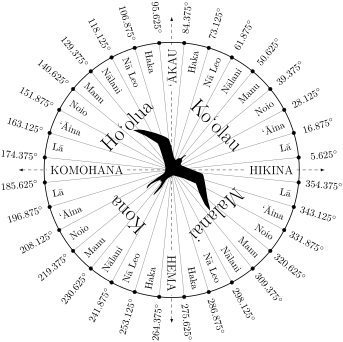
- Ask students to first determine the boundary between Hikina and Lā. (answer: \(5.625^{\circ}\))
- Next, determine the boundary between Lā and ʻĀina. (answer: \(16.875^{\circ}\))
-
Group Discussion
- Have students share their methods for arriving at the answers.
-
Determining Boundaries for All of Quadrant Koʻolau
-
Ask students to calculate the boundaries for all houses in quadrant Koʻolau.
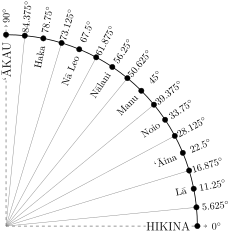
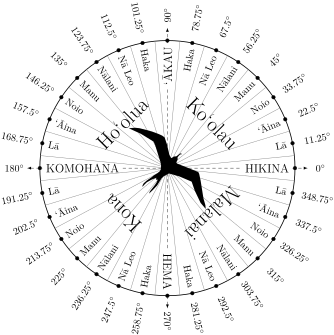
Figure 1.7. The quadrant Koʻolau for the Star Compass, with the angles labeled for the center of each house. - Discuss the results as a class, allowing students to share their approaches and insights.
-
-
Completing the Star Compass
-
Pptions for students to complete the angles for the center and boundaries of houses for the entire Star Compass:
- Individual completion.
- Group assignment (assigning specific quadrants or the entire Star Compass).
- Homework assignment.
-
Section 1.3 Lesson 3: Drawing the Circle
In this lesson, we will transition from theoretical Star Compass construction to practical implementation. We’ll discuss the challenges of moving from paper to reality, exploring strategies to overcome these challenges. The class will engage in drawing the actual Star Compass circle at the designated site, such as a flagpole.
- Materials for Classroom - Compass (Math Instrument)
- Materials for Outside - Kaula (Rope), Chalk, Paint/Paint Brush
Subsection 1.3.1 Classroom: What is a Circle
We will begin inside the classroom.
What is the main shape of the Star Compass? Ans: Circle
What is a circle? How do we draw a circle?
Ans: A circle is a shape that is round. To draw a circle, imagine drawing a line all the way around a point, keeping the same distance from that point. No matter where you look on the circle, the distance to the center is the same. The center is like the middle point of the circle, and the distance from the center to any point on the edge is called the radius. If you draw a line straight through the center and out the other side, that’s called the diameter, and it’s like the longest line you can make inside the circle. The distance around the circle is called the circumference.
Knowing this, have the students draw a circle on their papers. Next have them identify the center, are all points on the circle the same distance to the center?
Have students discuss how they created their circles.
Ask a student to draw a circle on the board. Discuss with the class how the circle was created.
Let students discuss the following for 5 minutes: What is needed to make a perfect circle on paper? Have students create their own perfect circle using supplies found in the classroom (do not use a compass).
Relate what the students used to create their circle to how you would use a compass (the math instrument, not the navigation instrument)? Why is a compass such a great tool to create a perfect circle? What else could we use to achieve this?
Subsection 1.3.2 Outside: Making a Circle
We will now move outside to the location of the Star Compass, in this case, we are constructing it at a flagpole. You will need to bring kaula (rope) and chalk.
If necessary, allow students a few minutes to draw with chalk on the sidewalk or on construction paper to get it out of their system so they will be able to focus once we begin to draw the Star Compass.
How can we create a circle around this flagpole using what is here with us? Ans: We can use the kaula to create a fixed length (or radius) and use chalk to trace the circle.
How would we hold the kaula to the center of the circle (the flagpole)? Let students discuss, keeping in mind that we donʻt want to have someone hold it for very long or else they may get tired and we may need multiple days to actually build this and we donʻt want people staying overnight holding the kaula.
Students should conclude that we can tie the rope to the pole. What type of knot would be best for securing the kaula to the pole? Review knots and their uses (
https://www.kanehunamoku.org/knots.html):- Hīpuʻu Walu (Figure 8 Knot):
- Function: Stopper Knot
- Uses: Ends of lashings; end of jib sheet lines
- Hīpuʻu Palu (Square Knot):
- Function: Tie two lines of the same diamter (size) together
- Uses: Reef in the sail; Close the sail bag
- Kapolina (Bowline):
- Function: Tie a secure loop at the END of a line
- Uses: Secure jib sheet lines to the jib sheet block; secure jib halyard to the head of the sail; secure shower bucket
- Bowline on a bight:
- Function: Tie a secure loop in the MIDDLE of a line
- Uses: Tighten the stays and secure through donuts
- Kūpeʻe Puaʻa (Clove Hitch):
- Function: Secure an item around a pole or post
- Uses: Secure bumpers to the railing or ʻiako; secure a bundle of line to the railings
Now after having reviewed the various knots, ask students which knot they think should be used to secure the kaula to the flagpole. Based on the review, students may think that a clove hitch is the best method. Letʻs test a clove hitch and see what happens.
Ask a student to secure the kaula to the flagpole by tying a clove hitch, you will want to use a smaller kaula so that the loose end is only 5 feet. Then ask another student hold the other end of the kaula and pull it away from the flagpole so that the kaula is tight. Then ask that student to continue holding the kaula so it stays tight and to walk around the flagpole for one revolution. The steps of the student should create the circle is. Ask the class if the student ended up in the same spot, creating a perfect circle. If we were tracing the steps, the student should actually be a little closer to the flagpole than when they began but it might not be noticeable to students since we arenʻt tracing the steps yet. Now have the student walk around the flagpole several more times. The kaula should start to wrap around the flagpole and the working end becomes shorter until the student walking around is almost to the flagpole. Walking around the flagpole several times should make it clear to students the kaula is getting shorter.
Ask students what happened to the kaula. Ans: it got shorter.
Have students discuss with their neighbors why they think the kaula got shorter. Did we still make a circle, even though the kaula got shorter? Why/why not?
With the whole class, ask why did it get shorter? Ans: It got shorter because the kaula started to wrap around the pole instead of going straight to the edge of the circle.
Ask the class to remember from the start of class what is a circle. Answer: A line where every part of it always has the same distance from the center.
From what we just did with the kaula, is the distance the same or does it change? Ans: It changes so we cannot use this knot to create a circle.
What other knots could we use? Ans: We can make a bowline on a pole so when we walk around the circle, the loop securing the kaula to the pole moves with us and doesnʻt wrap around the pole.
Have a student secure the kaula to the flagpole using a bowline then ask another student hold the working end of the kaula pull the kaula away from the flagpole so that the kaula is tight and then walk around the circle several times to demonstrate the distance from the flagpole to the end does not change. We have just successfully demonstrate designing a perfect circle.
Now we are ready to draw the circle. Ask students how to draw a circle using the kaula and chalk. Remind them of the problems when the kaula wrapped around the pole so we need to make sure the chalk is on the same spot on the kaula. If we hold the chalk at the end of the kaula, we cannot move how our hand is holding it of risk having a different length. A clove hitch around the chalk is preferred for ease of adjusting the length of the kaula but a bowline is also possible with the chalk placed in the loop. Hold the chalk and pull it away from the flagpole so that the kaula between the chalk and the flagpole is tight, and walk around the flagpole, tracing the outline of the circle with the chalk.
Is this the size of the circle you want? You can adjust the knots of the bowline to make the radius of the circle fit your needs and repeat the process.
Subsection 1.3.3 The Star Compass Circle
We are now ready to make the permanent circle for the Star Compass.
Verify with officials the dimension of the Star Compass that you are to construct, and determine the radius. For example, you may be asked to create a Star Compass within a 10 foot area, this represents the diameter of the circle, so your radius will be 5 feet. Next, adjust the length of the kaula to correspond with the radius.
Now that you have the appropriate length of kaula for your radius, draw another circle with chalk. Do not lose track of this line because you will be painting over it shortly.
Make a second circle, with a radius approximately one foot shorter than the previous circle, repeating the steps we did before. The two circles will be the boundaries of where we will eventually label the names of the houses.
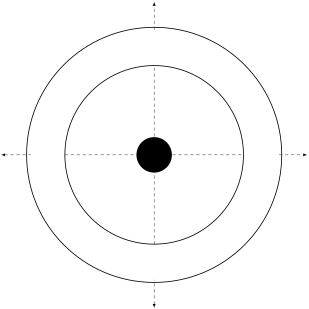
Using the chalk lines, paint the outer and inner circles. Your Star Compass should look like that in the figure below , without the dashed lines which are just to help us visualize the cardinal directions.
Let the paint dry and return to the classroom.
Subsection 1.3.4 Summary
Subsubsection 1.3.4.1 What is a Circle
Inside the classroom, we will begin by discussing the main shape of the Star Compass.
1. Discuss the primary shape of the Star Compass. - Answer: Circle
2. Define a circle and the process of drawing one. - Answer: A circle is a round shape. To draw a circle, envision drawing a line around a point, maintaining the same distance from that point. The center is the midpoint, and the distance from the center to any point on the edge is the radius. The diameter is a line through the center, and the distance around the circle is the circumference.
3. Activity: Have students draw circles, identify the center, and discuss their methods. Display a circle on the board, discussing how it was created.
4. Class Discussion: Encourage students to share their experiences in drawing circles, discussing the tools used and the challenges faced.
Subsubsection 1.3.4.2 Outside: Making a Circle
Move outside to the flagpole and discuss methods to create a circle using available materials.
-
Discuss how to create a circle around the flagpole using available materials.Answer: Use kaula (rope) to establish a fixed length (radius) and trace the circle with chalk.
-
Considerations: Explore how to secure the kaula to the flagpole without human assistance. Introduce various knots and their uses:
- Hīpuʻu Walu (Figure 8 Knot): Stopper Knot
- Hīpuʻu Palu (Square Knot): Tie two lines of the same diameter together
- Kapolina (Bowline): Tie a secure loop at the end of a line
- Bowline on a bight: Tie a secure loop in the middle of a line
- Kūpeʻe Puaʻa (Clove Hitch): Secure an item around a pole or post
- Knot Experiment: Test a clove hitch and observe the kaula shortening. Discuss why it happened.
- Solution: Introduce the bowline knot and demonstrate its effectiveness in maintaining a consistent length.
- Circle Drawing: Use the chalk and kaula to draw a circle, ensuring the chalk remains at a fixed point on the kaula. Discuss adjustments to the knots for different circle sizes.
Subsubsection 1.3.4.3 The Star Compass Circle
- Determine the required dimensions of the Star Compass, including the radius.
- Adjust Kaula: Modify the kaula’s length to match the radius.
- Draw Circles: Use the adjusted kaula to draw the outer and inner circles with chalk.
- Paint Circles: Paint over the chalk lines, creating the final Star Compass circles.
- Completion: Once the paint dries, the Star Compass circle is ready for further construction.
Section 1.4 Lessons 4 and 5: Installing Star Compass Houses
Before going outside, review with the students the shape of the Star Compass (circle), how the position of each house was obtained by halving distances, and how the boundaries of the houses were obtained by halving the distances between the centers of the houses. You will need at least two pieces of kaula.
Subsection 1.4.1 Cardinal-Directions
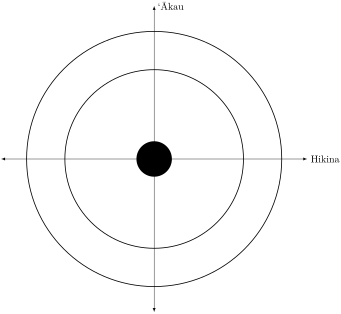
At the site of the Star Compass, begin by attaching kaula to the flag pole using a bowline, making sure the length of the kaula reaches to the end of the outer circle or longer. Keep this kaula attached for the remainder of the lesson.
Using a modern compass (a cell phone with a compass is good), stand at the flagpole and move around the base until you are facing North (ʻĀkau). Ask a student to hold the kaula tight on the ground in the direction of North. Trace over this line with chalk to mark the direction. Repeat the steps for the remaining cardinal directions: East (Hikina), South (Hema), and West (Komohana).
Subsection 1.4.2 Finding-Manu
Now that we know East (Hikina) and North (ʻĀkau), ask students what is the next house we locate and why? Ans: We locate Manu because it is halfways between Hikina and ʻĀkau.
In the other days when we practiced building the Star Compass, we just estimated where halfway is, but we need to be precise. How do we find where halfway is between the Hikina and ʻĀkau? Let students discuss. If necessary, use the kaula to connect the part where Hikina intersects the outer circle to the part where ʻĀkau intersects the outer circle.
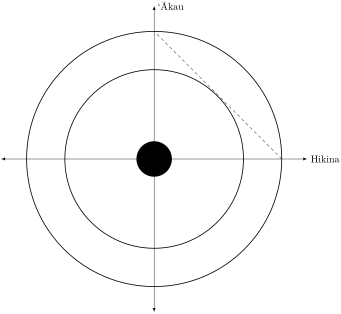
Now that students see the line, ask how to find halfway on the line? Although using a measuring tape to find the length and dividing that measurement in half does work, a simplier solution would be to fold the kaula in half. Before doing this, trace the line with chalk. Now you can fold the kaula in half to determine the halfway point on the kaula which is the halfway point on the line between Hikina and ʻĀkau. Use chalk to mark this halfway point.
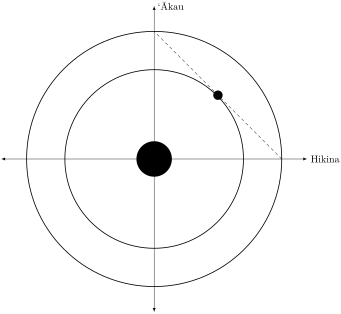
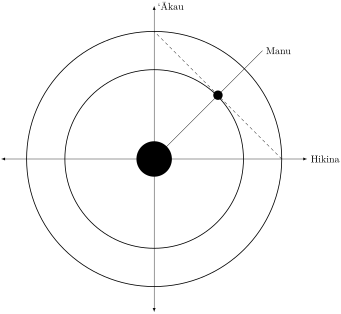
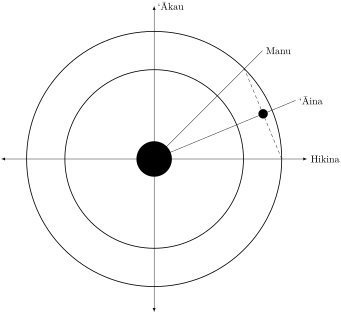
With the kaula that is secured to the flag pole, extend it through this point to the outer circle and trace the line with chalk. This line is the center of the house Manu. You may also erase the chalk line connecting Hikina to ʻĀkau.
Subsection 1.4.3 Finding ʻĀina
The next house to be located is ʻĀina, which is halfway between Hikina and Manu.
Using the method of locating halfway that we used for Manu, we will start by connecting kaula from the point where Hikina intersects with the outer circle to the point where Manu intersects with the outer circle, and using the method of folding the kaula in half, locate the halfway point, marking it with chalk. Note: it is important that you are using the points that intersect the outer circle.
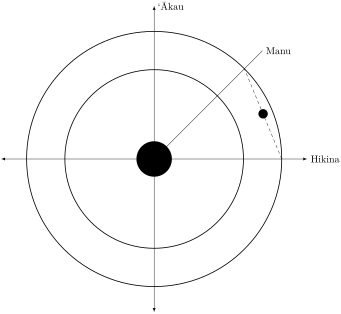
Extend the kaula attached to the flag pole over the point you just marked and to the outer circle. Trace this line with chalk. This is the center of the house ʻĀina. You may erase the chalk line connecting Hikina with Manu.
Subsection 1.4.4 Finding the Center of the Houses
Using the methods we learned in Lesson 1, Continue this process until the center of all the houses are marked.
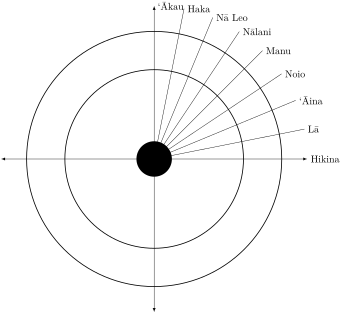
You may want to clean up the area and erase the house lines that are between the flag pole and the inner circle.
Subsection 1.4.5 Locating the Boundary between Hikina and Lā
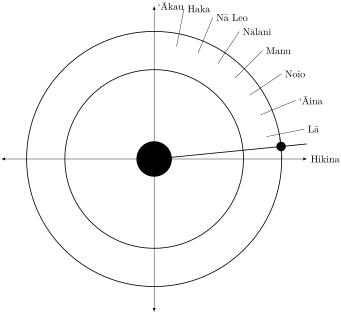
Now that we found the center of the houses, we are ready to locate the boundaries. To locate the boundary between Hikina and Lā, we use the method of connecting the intersection of Hikina and the outer circle to the intersection of Lā and the outer circle, then find the halfway point, and extend a line from the flag pole, past this point to the outer circle.
Subsection 1.4.6 Locating House Boundaries
Repeat this process of locating the boundaries for all houses.
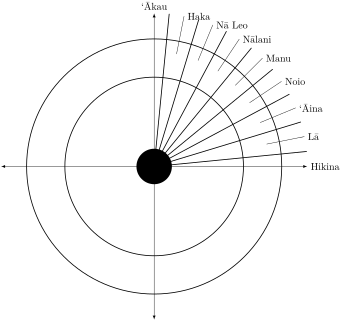
We now have the outline for each house and can paint over the chalk outlines for the house boundaries.
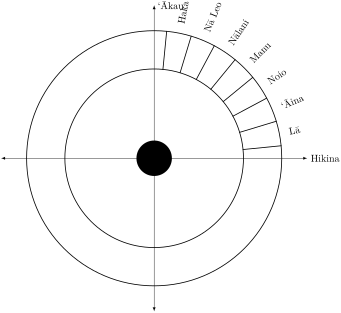
Subsection 1.4.7 The Finished Star Compass
The outline of the Star Compass is complete. Now you can decorate and color the Star Compass and add the names of the houses and quadrants.