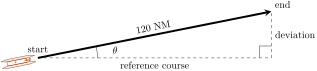
In Section 1.4, we used right triangles to determine the deviation of a waʻa (canoe) from its course based on the angle of deviation. If a waʻa sails for 120 nautical miles (NM), we were able to calculate the deviation from its course using right triangles to get the equation:
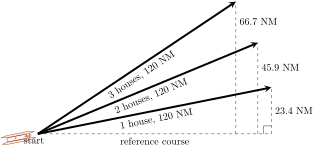
Before setting sail, a voyager studies a table listing the deviation distances corresponding to different houses of deviation. It’s crucial to understand that while adding angles may yield a third angle, adding their corresponding deviations will not accurately determine the total deviation. In other words:
These calculations demonstrate that the deviation distances for multiple houses cannot be determined by simply adding individual deviations, highlighting the importance of understanding trigonometric principles for accurate navigation. In this section, we will explore the formulas for the addition and subtraction of angles in trigonometric functions.
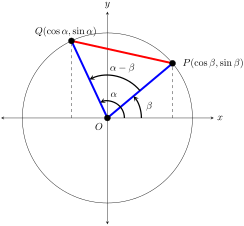
We begin by considering two points on the unit circle. Point \(P\) is at an angle of \(\beta\) in standard position with coordinates \((\cos\beta,\sin\beta)\) and point \(Q\) is at an angle of \(\alpha\) in standard position with coordinates \((\cos\alpha,\sin\alpha)\text{.}\)
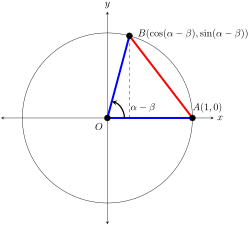
Next, consider two additional points on a second unit circle. Point \(A\) has coordinates \((1,0)\) and Point \(B\) is at an angle of \(\alpha-\beta\) in standard position with coordinates \((\cos(\alpha-\beta),\sin(\alpha-\beta))\text{.}\)
Note that since \(OP\text{,}\)\(OQ\text{,}\)\(OA\text{,}\) and \(OB\) are line segments from the center to points on the unit circle, they are congruent and have length of 1. Also note that \(\angle POQ=\angle AOB=\alpha-\beta\text{.}\) Since two sides and the included angle of \(\triangle OPQ\) and \(\triangle OAB\) are congruent, we can conclude by the Side-Angle-Side Theorem (SAS) in geometry that the two triangles are congruent. Thus, corresponding sides have the same lengths, giving us \(d(P,Q)=d(A,B)\text{.}\) Substituting our results for \(d(P,Q)\) and \(d(A,B)\) we get
To prove the Addition Formula for Cosine, replace \(\beta\) with \(-\beta\) in the Subtraction Formula and use the Even and Odd Trigonometric Properties (Definition 1.5.22) where \(\sin(-\beta)=-\sin\beta\) and \(\cos(-\beta)=\cos\beta\) to get
We will prove the Addition Formula for Sine in Example 3.2.10 and the Subtraction Formula can be established using the Even and Odd Properties (Definition 1.5.22).
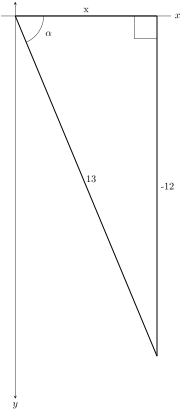
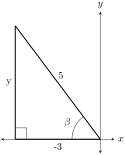
Given \(\sin\alpha=-\frac{12}{13}\text{,}\) with \(\frac{3\pi}{2}\lt \alpha\lt 2\pi\) and \(\cos\beta=-\frac{3}{5}\text{,}\) with \(\frac{\pi}{2}\lt \beta\lt \pi\text{,}\) find the exact value of \(\sin(\alpha+\beta)\text{.}\)
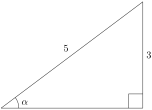
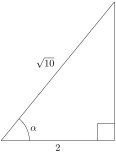
Given \(\sin\alpha=-\frac{12}{13}\) with \(\frac{3\pi}{2}\lt \alpha\lt 2\pi\) and \(\cos\beta=-\frac{3}{5}\) with \(\frac{\pi}{2}\lt \beta\lt \pi\text{,}\) we can draw the following triangles associated with \(\alpha\) and \(\beta\text{,}\) respectively:
Recall that \(\tan\theta=\frac{\sin\theta}{\cos\theta}\) as long as \(\cos\theta\neq0\text{.}\) Using this fact and our new formulas for the sum of sine and cosine, we get
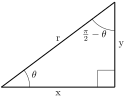
We will prove the Cofunction Identity for \(\sin\theta\) in Example 3.2.9. The proof for \(\cos\theta\) is given as Exercise 3.2.7.97. The Cofunction Identities for \(\tan\theta\) and \(\cot\theta\) can be found using the Quotient Identities (Definition 1.4.3); for \(\csc\theta\) and \(\sec\theta\) can be found using the Reciprocal Identities (Definition 1.4.2).
To establish an identity, we will start from one side of the equation and use properties to end up with the expression on the other side of the equation. So,
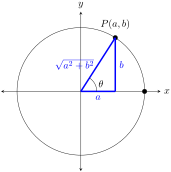
For any real numbers \(a\) and \(b\text{,}\) let \(\theta\) be an angle in standard position where \(P(a,b)\) is a point on the terminal side of \(\theta\text{.}\) Then
\begin{equation*}
a \sin x + b \cos x = \sqrt{a^2 + b^2} \sin(x + \theta)\text{.}
\end{equation*}
We begin by considering the triangle formed by angle \(\theta\) and point \(P(a,b)\text{,}\) shown in Figure 3.2.12. By the Pythagorean Theorem, the hypotenuse of this triangle, with base \(a\) and height \(b\text{,}\) is \(\sqrt{a^2+b^2}\text{.}\) According to Definition 1.4.1, we have
Therefore, using the addition formula for sine, we get
\begin{align*}
a \sin x + b \cos x \amp = \sqrt{a^2+b^2}\cos\theta\sin x + \sqrt{a^2+b^2}\sin\theta\cos x \\
\amp = \sqrt{a^2+b^2}\left(\cos\theta\sin x + \sin\theta\cos x\right) \\
\amp = \sqrt{a^2+b^2}\sin(x+\theta) \text{.}
\end{align*}
To express the given expression in terms of sine only, we will use Definition 3.2.11. Considering the point \(P(a,b)=\left( -\frac{\sqrt{3}}{2},\frac{1}{2}\right)\text{,}\) which lies in Quadrant II, we determine the angle \(\theta\text{.}\) Using either Table 1.5.18 or inverse trigonometric methods where
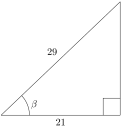
Find the exact of each expression given \(\sin\alpha=\frac{20}{29}\text{,}\)\(0\lt\alpha\lt\frac{\pi}{2}\) and \(\cos\beta=\frac{24}{25}\text{,}\)\(0\lt\beta\lt\frac{\pi}{2}\)
Find the exact value of each expression given \(\tan\alpha=\frac{8}{15}\text{,}\)\(\pi\lt\alpha\lt\frac{3\pi}{2}\) and \(\cos\beta=-\frac{3}{5}\text{,}\)\(\frac{\pi}{2}\lt\beta\lt\pi\)