Skip to main content
Contents Index
Search Book
Search Results:
No results.
Calculator
Read aloud Readability settings Prev Up Next Scratch ActiveCode \(\newcommand{\sectionbreak}{\clearpage}
\usepackage{cancel}
\newcommand{\lt}{<}
\newcommand{\gt}{>}
\newcommand{\amp}{&}
\definecolor{fillinmathshade}{gray}{0.9}
\newcommand{\fillinmath}[1]{\mathchoice{\colorbox{fillinmathshade}{$\displaystyle \phantom{\,#1\,}$}}{\colorbox{fillinmathshade}{$\textstyle \phantom{\,#1\,}$}}{\colorbox{fillinmathshade}{$\scriptstyle \phantom{\,#1\,}$}}{\colorbox{fillinmathshade}{$\scriptscriptstyle\phantom{\,#1\,}$}}}
\)
Section 1.5 Trigonometric Functions of Any Angle
Now that we have been introduced to the six trigonometric functions for special angles in the first quadrant, we can explore their properties across all quadrants.
Subsection 1.5.1 Determine the Signs of the Trigonometric Functions Based on the Quadrant
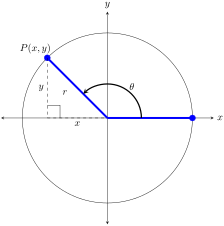
Let
\(P(x,y)\) be a point on the circle. The signs of the six trigonometric functions vary depending on the quadrant in which
\(P(x,y)\) lies in.
Example 1.5.1 .
Let
\(P(x,y)\) be in Quadrant II. Determine the sign for each of the six trigonometric functions.
Solution .
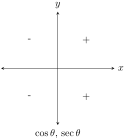
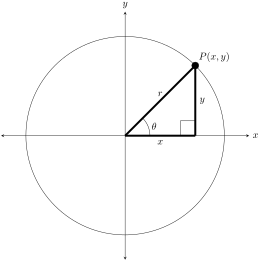
Since \(P(x,y)\) is in Quadrant II, \(x\lt 0\) and \(y>0\text{.}\) Note that \(r>0\text{.}\) Then we have
\begin{align*}
\sin\theta\amp =\frac{y}{r}=\frac{(+)}{(+)}=(+), \amp \cos\theta\amp =\frac{x}{r}=\frac{(-)}{(+)}=(-), \amp \tan\theta\amp =\frac{y}{x}=\frac{(+)}{(-)}=(-),\\
\csc\theta\amp =\frac{r}{y}=\frac{(+)}{(+)}=(+), \amp \sec\theta\amp =\frac{r}{x}=\frac{(+)}{(-)}=(-), \amp \cot\theta\amp =\frac{x}{y}=\frac{(-)}{(+)}=(-)\text{.}
\end{align*}
We can check the remaining quadrants using a similar approach.
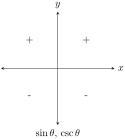
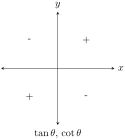
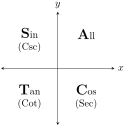
Table 1.5.2 and
Figure 1.5.3 provide a list of the signs of the six trigonometric functions for each quadrant.
Table 1.5.2. Signs of the trigonometric functions.
Quadrant
Positive Functions
Negative Functions
I
all
none
II
sin\(\theta\text{,}\) csc\(\theta\)
cos\(\theta\text{,}\) sec\(\theta\text{,}\) tan\(\theta\text{,}\) cot\(\theta\)
III
tan\(\theta\text{,}\) cot\(\theta\)
sin\(\theta\text{,}\) csc\(\theta\text{,}\) cos\(\theta\text{,}\) sec\(\theta\)
IV
cos\(\theta\text{,}\) sec\(\theta\)
sin\(\theta\text{,}\) csc\(\theta\text{,}\) tan\(\theta\text{,}\) cot\(\theta\)
Figure 1.5.3. Signs of trigonometric functions.
Example 1.5.4 .
If
\(\sin\theta\lt 0\) and
\(\cos\theta>0\text{,}\) what quadrant does
\(\theta\) lie in?
Solution .
Since
\(\sin\theta\lt 0\text{,}\) then
\(\theta\) is either in Quadrant III or IV. However, we also have
\(\cos\theta>0\) which means that
\(\theta\) is either in Quadrant I or IV. Thus the only quadrant that satisfies both conditions is Quadrant IV.
Mnemonic devices for remembering the quadrants in which the trigonometric functions are positive are
“
A ll
S tudents
T ake
C alculus”
which correspond to “
A ll
S in
T an
C os.”
Example 1.5.5 .
Let
\(\sin\theta=-\frac{12}{13}\) and
\(\cos\theta=-\frac{5}{13}\text{.}\) Compute the exact values of the remaining trigonometric functions of
\(\theta\) using identities.
Solution .
Since
\(\sin\theta\lt 0\) and
\(\cos\theta\lt 0\text{,}\) we refer to
Table 1.5.2 and see that
\(\theta\) is in Quadrant III. From
Table 1.5.2 we know
\(\tan\theta>0\text{,}\) \(\csc\theta\lt 0\text{,}\) \(\sec\theta\lt 0\text{,}\) \(\cot\theta>0\text{.}\) From the Quotient Identity (
Definition 1.4.3 ), we have
\begin{equation*}
\tan\theta=\frac{\sin\theta}{\cos\theta}=\frac{\frac{12}{13}}{\frac{5}{13}}=\frac{12}{5}\text{.}
\end{equation*}
\begin{align*}
\csc\theta\amp =\frac{1}{\sin\theta}=\frac{1}{-\frac{12}{13}}=-\frac{13}{12},\\
\sec\theta\amp =\frac{1}{\cos\theta}=\frac{1}{-\frac{5}{13}}=-\frac{13}{5},\\
\cot\theta\amp =\frac{1}{\tan\theta}=\frac{1}{\frac{12}{5}}=\frac{5}{12}\text{.}
\end{align*}
Subsection 1.5.2 Reference Angles
Now that we can determine the signs of trigonometric functions, we will demonstrate how the value of any trigonometric function at any angle can be found from its value in Quadrant I (between
\(0^{\circ}\) and
\(90^{\circ}\) or 0 and
\(\frac{\pi}{2}\) ).
Definition 1.5.6 .
Let
\(t\) be a real number. A
reference angle ,
\(t'\text{,}\) is the acute angle (
\(\lt 90^{\circ}\) ) formed by the terminal side of angle
\(t\) and the
\(x\) -axis. In other words, it is the shortest arc length along the unit circle measured between the terminal side and the
\(x\) -axis. Angles in Quadrant I are their own reference angles.
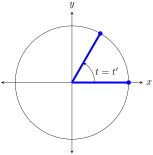
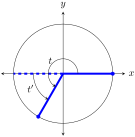
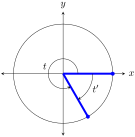
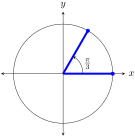
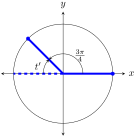
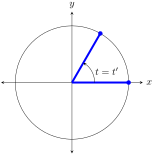
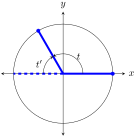
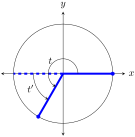
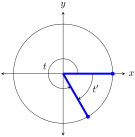
Example 1.5.8 .
Find the reference angle for each value of
\(t\text{.}\)
(a)
Solution .
The angle
\(t=\frac{\pi}{3}\) is in the first quadrant and so it is its own reference angle:
\(t=t'=\frac{\pi}{3}\text{.}\)
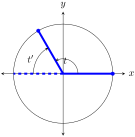
(b)
Solution .
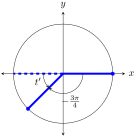
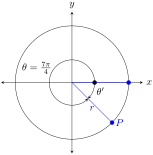
From the figure, we see that the shortest arc length to the
\(x\) -axis is in the direction of
\(\pi\text{.}\) We see that
\(t'+\frac{3\pi}{4}=\pi\) so
\(t'=\pi-\frac{3\pi}{4}=\frac{\pi}{4}\text{.}\)
(c)
Solution 1 .
Since
\(t \lt 0\text{,}\) we can add
\(2\pi\) to get
\(-\frac{3\pi}{4}+2\pi=\frac{5\pi}{4}\text{.}\) From the formula, we get
\(t'=\frac{5\pi}{4}-\pi=\frac{\pi}{4}\text{.}\)
Solution 2 .
Since
\(-\frac{3\pi}{4}\) spans only two quadrants counterclockwise, we can treat it similarly to an angle in Quadrant II. By the previous problem,
\(t'+\frac{3\pi}{4}=\pi\) so
\(t'=\pi-\frac{3\pi}{4}=\frac{\pi}{4}\text{.}\)
(d)
Solution .
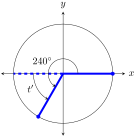
From the figure we see that the shortest arc length to the
\(x\) -axis is towards
\(180^{\circ}\text{.}\) We observe that
\(240^{\circ}-t'=180^{\circ}\) so
\(t'=240^{\circ}-180^{\circ}=60^{\circ}\text{.}\)
(e)
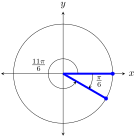
Solution .
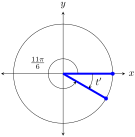
From the figure, we see that the shortest arc length to the
\(x\) -axis is towards
\(2\pi\text{.}\) We observe that
\(t'+\frac{11\pi}{6}=2\pi\) so
\(t'=2\pi-\frac{11\pi}{6}=\frac{\pi}{6}\text{.}\)
(f)
Solution .
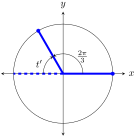
From the figure, we see that the shortest arc length to the
\(x\) -axis is towards
\(\pi\text{.}\) We observe that
\(t'+\frac{2\pi}{3}=\pi\) so
\(t'=\pi-\frac{2\pi}{3}=\frac{\pi}{3}\text{.}\)
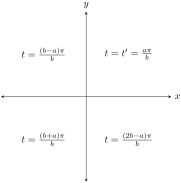
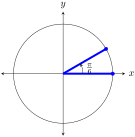
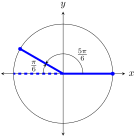
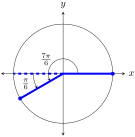
Example 1.5.10 . Calculate an angle given its reference angle and quadrant.
Given a reference angle,
\(t\text{,}\) compute the associated angle in standard position for Quadrants II, III, and IV.
(a) (i)
Solution 1 .
In Quadrant II, the associated angle is
\(t=\pi-\frac{\pi}{6}=\frac{6\pi}{6}-\frac{\pi}{6}=\frac{5\pi}{6}\text{.}\)
Solution 2 .
Since
\(t'=\frac{\pi}{6}=\frac{1\pi}{6}\text{,}\) then
\(t'=\frac{(6-1)\pi}{6}=\frac{5\pi}{6}\text{.}\)
(ii)
Solution 1 .
In Quadrant III, the associated angle is
\(t=\pi+\frac{\pi}{6}=\frac{6\pi}{6}+\frac{\pi}{6}=\frac{7\pi}{6}\text{.}\)
Solution 2 .
\(t'=\frac{(6+1)\pi}{6}=\frac{7\pi}{6}\text{.}\)
(iii)
Solution 1 .
In Quadrant IV, the associated angle is
\(t=2\pi-\frac{\pi}{6}=\frac{12\pi}{6}-\frac{\pi}{6}=\frac{11\pi}{6}\text{.}\)
Solution 2 .
\(t'=\frac{(2\cdot6-1)\pi}{6}=\frac{11\pi}{6}\text{.}\)
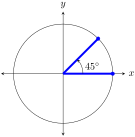
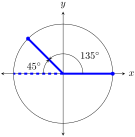
(b) (i)
Solution .
In Quadrant II, the associated angle is
\(t=180^{\circ}-45^{\circ}=135^{\circ}\text{.}\)
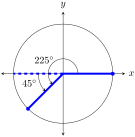
(ii)
Solution .
In Quadrant III, the associated angle is
\(t=180^{\circ}+45^{\circ}=225^{\circ}\text{.}\)
(iii)
Solution .
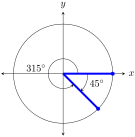
In Quadrant IV, the associated angle is
\(t=360^{\circ}-45^{\circ}=315^{\circ}\text{.}\)
Subsection 1.5.3 Evaluating Trigonometric Functions Using Reference Angles
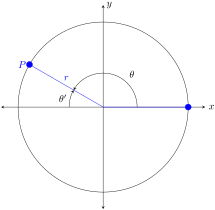
To evaluate trigonometric functions in any quadrant using reference angles, we begin with an angle,
\(\theta\text{,}\) that lies in Quadrant II. When evaluating
\(\sin\theta\) and
\(\cos\theta\text{,}\) we begin by plotting
\(\theta\) in standard position and then proceed to determine and draw its corresponding reference angle,
\(\theta'.\)
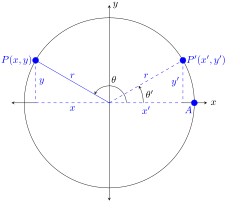
By definition we know that
\begin{equation*}
\sin\theta=\frac{y}{r};\qquad\cos\theta=\frac{x}{r}\text{.}
\end{equation*}
Next, we draw the reference angle,
\(\theta'\text{,}\) in standard position.
We now have
\begin{equation*}
\sin\theta'=\frac{y'}{r};\qquad\cos\theta'=\frac{x'}{r}\text{.}
\end{equation*}
Notice that the \(y\) -coordinates for \(P\) and \(P'\) share the same value, thus \(y=y'\) and we get
\begin{equation*}
\sin\theta=\sin\theta'\text{.}
\end{equation*}
Similarly, we can see that the \(x\) -coordinates of \(P\) and \(P'\) have opposite values, thus \(x=-x'\) and
\begin{equation*}
\cos\theta=-\cos\theta'\text{.}
\end{equation*}
You may have noticed that we have two similar triangles, differing only in their
\(x\) -coordinates have opposite values. Consequently, the values of each trigonometric function for the two triangles will match, except for a potential difference in signs. The sign of each function can be deduced by referring to
Table 1.5.2 . This approach is applicable across all quadrants. To sum up, we now outline the steps for utilizing reference angles to evaluate trigonometric functions.
Example 1.5.12 .
Use the reference angle associated with the given angle to find the exact value of:
(a)
Solution .
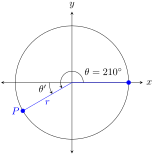
We will use the steps for evaluating trigonometric functions using reference angles.
First we draw the angle
\(\theta=210^{\circ}\text{.}\)
The reference angle is
\begin{equation*}
\theta'=210^{\circ}-180^{\circ}=30^{\circ}\text{.}
\end{equation*}
\(\cos30^{\circ}=\frac{\sqrt{3}}{2}\text{.}\)
Since \(210^{\circ}\) lies in Quadrant III, we know that \(\cos\theta\lt 0\text{,}\) so
\begin{equation*}
\cos210^{\circ}=-\frac{\sqrt{3}}{2}\text{.}
\end{equation*}
(b)
Solution .
We will use the steps for evaluating trigonometric functions using reference angles.
First we draw the angle
\(\theta=\frac{7\pi}{4}\text{.}\)
The reference angle is
\begin{equation*}
2\pi-\frac{7\pi}{4}=\frac{8\pi}{4}-\frac{7\pi}{4}=\frac{\pi}{4}\text{.}
\end{equation*}
\(\tan\frac{\pi}{4}=1\text{.}\)
Since \(\frac{7\pi}{4}\) lies in Quadrant IV, we know that \(\tan\theta\lt 0\text{,}\) so
\begin{equation*}
\tan\frac{7\pi}{4}=-1
.
\end{equation*}
Example 1.5.13 .
Calculate
\(\sin\theta\) and
\(\cos\theta\) if
\(\theta=\frac{20\pi}{3}\text{.}\)
Solution .
First we draw the angle
\(\theta=\frac{20\pi}{3}\text{.}\)
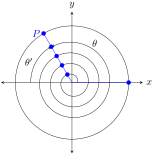
Figure 1.5.14. The angle \(\theta=\frac{20\pi}{3}\) makes three rotations before ending in Quadrant II.
To obtain the reference angle, we first subtract multiples of \(2\pi\) from \(\theta\) to obtain a coterminal angle between \(0\) and \(2\pi\text{:}\)
\begin{align*}
\frac{20\pi}{3}-2\pi =\amp \frac{20\pi}{3}-\frac{6\pi}{3}=\frac{14\pi}{3},\\
\frac{20\pi}{3}-4\pi =\amp \frac{20\pi}{3}-\frac{12\pi}{3}=\frac{8\pi}{3},\\
\frac{20\pi}{3}-6\pi =\amp \frac{20\pi}{3}-\frac{18\pi}{3}=\frac{2\pi}{3}\text{.}
\end{align*}
From
Example 1.5.8 , the reference angle for
\(\frac{2\pi}{3}\) is
\(\theta'=\frac{\pi}{3}\text{.}\)
\(\sin\frac{\pi}{3}=\frac{\sqrt{3}}{2}\) and
\(\cos\frac{\pi}{3}=\frac{1}{2}\text{.}\)
Since \(\frac{20\pi}{3}\) lies in Quadrant II, we know that \(\sin\theta>0\) and \(\cos\theta\lt 0\text{,}\) so
\begin{equation*}
\sin\frac{20\pi}{3}=\frac{\sqrt{3}}{2}; \qquad \cos\frac{20\pi}{3}=-\frac{1}{2}\text{.}
\end{equation*}
Subsection 1.5.4 Periodic Functions
In
Figure 1.5.14 of
Example 1.5.13 , point
\(P\) corresponds to the angle
\(\frac{20\pi}{3}.\) To determine the reference angle, we subtracted multiples of
\(2\pi.\) Each iteration of
\(2\pi\) retraces the unit circle back to the point
\(P\text{,}\) resulting in a coterminal angle. Therefore
\begin{equation*}
\sin\frac{2\pi}{3}=\sin\frac{8\pi}{3}=\sin\frac{14\pi}{3}=\sin\frac{20\pi}{3}\text{.}
\end{equation*}
Rewriting the angles we get
\begin{equation*}
\sin\left(\frac{2\pi}{3}+0\cdot2\pi\right)=\sin\left(\frac{2\pi}{3}+1\cdot2\pi\right)=\sin\left(\frac{2\pi}{3}+2\cdot2\pi\right)=\sin\left(\frac{2\pi}{3}+3\cdot2\pi\right)\text{.}
\end{equation*}
Similarly,
\begin{equation*}
\cos\left(\frac{2\pi}{3}+0\cdot2\pi\right)=\cos\left(\frac{2\pi}{3}+1\cdot2\pi\right)=\cos\left(\frac{2\pi}{3}+2\cdot2\pi\right)=\cos\left(\frac{2\pi}{3}+3\cdot2\pi\right)\text{.}
\end{equation*}
In general, consider an angle
\(\theta\) measured in radians and its corresponding point
\(P\) on the unit circle. Adding or subtracting integer multiples of
\(2\pi\) to
\(\theta\) will lead to the same point
\(P\) on the unit circle. Thus, the values of sine and cosine for all angles corresponding to point
\(P\) are equivalent. This leads us to the following periodic properties.
Definition 1.5.15 . Periodic Properties.
\begin{align*}
\sin(\theta+2\pi k)\amp =\sin\theta \amp \cos(\theta+2\pi k)\amp =\cos\theta
\end{align*}
where \(k\) is any integer.
Functions such as these that repeat their values in regular cycles are called
periodic functions .
Definition 1.5.16 .
A function \(f\) is called periodic if there exists a positive number \(p\) such that
\begin{equation*}
f(\theta+p)=f(\theta)
\end{equation*}
for every \(\theta.\) The smallest number \(p\) is called the period of \(f\text{.}\)
Sine, cosine, cosecant, and secant repeat their values with a period of
\(2\pi\) while tangent and cotangent have a period of
\(\pi\text{.}\)
Definition 1.5.17 . Periodic Properties.
\begin{align*}
\sin(\theta+2\pi)\amp =\sin\theta, \amp \cos(\theta+2\pi)\amp =\cos\theta, \amp \tan(\theta+\pi)\amp =\tan\theta,\\
\csc(\theta+2\pi)\amp =\csc\theta, \amp \sec(\theta+2\pi)\amp =\sec\theta, \amp \cot(\theta+\pi)\amp =\cot\theta\text{.}
\end{align*}
Subsection 1.5.5 Trigonometric Table
The Trigonometric Identities and reference angles give us the values of trigonometric functions in
Table 1.5.18 .
Table 1.5.18. Values of the six trigonometric functions for common angles (Undefined values are abbreviated as “undef”).
\(\theta\) (deg)
\(\theta\) (rad)
\(\sin\theta\) \(\cos\theta\) \(\tan\theta\) \(\csc\theta\) \(\sec\theta\) \(\cot\theta\)
\(0^{\circ}\) 0
0
1
0
undef
1
undef
\(30^{\circ}\) \(\dfrac{\pi}{6}\) \(\dfrac{1}{2}\) \(\dfrac{\sqrt{3}}{2}\) \(\dfrac{1}{\sqrt{3}}\) 2
\(\dfrac{2}{\sqrt{3}}\) \(\sqrt{3}\)
\(45^{\circ}\) \(\dfrac{\pi}{4}\) \(\dfrac{1}{\sqrt{2}}\) \(\dfrac{1}{\sqrt{2}}\) 1
\(\sqrt{2}\) \(\sqrt{2}\) 1
\(60^{\circ}\) \(\dfrac{\pi}{3}\) \(\dfrac{\sqrt{3}}{2}\) \(\dfrac{1}{2}\) \(\sqrt{3}\) \(\dfrac{2}{\sqrt{3}}\) 2
\(\dfrac{1}{\sqrt{3}}\)
\(90^{\circ}\) \(\dfrac{\pi}{2}\) 1
0
undef
1
undef
0
\(120^{\circ}\) \(\dfrac{2\pi}{3}\) \(\dfrac{\sqrt{3}}{2}\) \(-\dfrac{1}{2}\) \(-\sqrt{3}\) \(\dfrac{2}{\sqrt{3}}\) \(-2\) \(-\dfrac{1}{\sqrt{3}}\)
\(135^{\circ}\) \(\dfrac{3\pi}{4}\) \(\dfrac{1}{\sqrt{2}}\) \(-\dfrac{1}{\sqrt{2}}\) \(-1\) \(\sqrt{2}\) \(-\sqrt{2}\) \(-1\)
\(150^{\circ}\) \(\dfrac{5\pi}{6}\) \(\dfrac{1}{2}\) \(-\dfrac{\sqrt{3}}{2}\) \(-\dfrac{1}{\sqrt{3}}\) 2
\(-\dfrac{2}{\sqrt{3}}\) \(-\sqrt{3}\)
\(180^{\circ}\) \(\pi\) 0
\(-1\) 0
undef
\(-1\) undef
\(210^{\circ}\) \(\dfrac{7\pi}{6}\) \(-\dfrac{1}{2}\) \(-\dfrac{\sqrt{3}}{2}\) \(\dfrac{1}{\sqrt{3}}\) \(-2\) \(-\dfrac{2}{\sqrt{3}}\) \(\sqrt{3}\)
\(225^{\circ}\) \(\dfrac{5\pi}{4}\) \(-\dfrac{1}{\sqrt{2}}\) \(-\dfrac{1}{\sqrt{2}}\) 1
\(-\sqrt{2}\) \(-\sqrt{2}\) 1
\(240^{\circ}\) \(\dfrac{4\pi}{3}\) \(-\dfrac{\sqrt{3}}{2}\) \(-\dfrac{1}{2}\) \(\sqrt{3}\) \(-\dfrac{2}{\sqrt{3}}\) \(-2\) \(\dfrac{1}{\sqrt{3}}\)
\(270^{\circ}\) \(\dfrac{3\pi}{2}\) \(-1\) 0
undef
\(-1\) undef
0
\(300^{\circ}\) \(\dfrac{5\pi}{3}\) \(-\dfrac{\sqrt{3}}{2}\) \(\dfrac{1}{2}\) \(-\sqrt{3}\) \(-\dfrac{2}{\sqrt{3}}\) 2
\(-\dfrac{1}{\sqrt{3}}\)
\(315^{\circ}\) \(\dfrac{7\pi}{4}\) \(-\dfrac{1}{\sqrt{2}}\) \(\dfrac{1}{\sqrt{2}}\) \(-1\) \(-\sqrt{2}\) \(\sqrt{2}\) \(-1\)
\(330^{\circ}\) \(\dfrac{11\pi}{6}\) \(-\dfrac{1}{2}\) \(\dfrac{\sqrt{3}}{2}\) \(-\dfrac{1}{\sqrt{3}}\) \(-2\) \(\dfrac{2}{\sqrt{3}}\) \(-\sqrt{3}\)
Subsection 1.5.6 Pythagorean Identities
Definition 1.5.20 . Pythagorean Identities.
\(\displaystyle \sin^2\theta+\cos^2\theta=1\)
\(\displaystyle 1+\tan^2\theta=\sec^2\theta\)
\(\displaystyle 1+\cot^2\theta=\csc^2\theta\)
Proof. We will use the Pythagorean Theorem to prove the reciprocal identities.
Let \(P(x,y)\) be a point on the circle with radius \(r\text{.}\) The equation of the circle is
\begin{equation*}
x^2+y^2=r^2\text{.}
\end{equation*}
By definition \(\frac{x}{r}=\cos\theta\) and \(\frac{y}{r}=\sin\theta\text{.}\) Thus we have
\begin{equation*}
\sin^2\theta+\cos^2\theta=\left(\frac{y}{r}\right)^2+\left(\frac{x}{r}\right)^2=\frac{x^2+y^2}{r^2}=\frac{r^2}{r^2}=1
\end{equation*}
which is our first Pythagorean Identity. The proofs of the remaining identities are left as exercises.
Example 1.5.21 .
Let
\(\theta\) be an angle in Quadrant IV and let
\(\cos\theta=\frac{3}{5}\text{.}\) Calculate the exact values of
\(\sin\theta\) and
\(\tan\theta\text{.}\)
Solution .
Substituting our value of \(\cos\theta\) into the Pythagorean identity, we obtain:
\begin{align*}
\sin^2\theta+\cos^2\theta\amp = 1\\
\sin^2\theta+\left(\frac{3}{5}\right)^2\amp = 1\\
\sin^2\theta+\frac{9}{25}\amp = 1\\
\sin^2\theta\amp = 1-\frac{9}{25}\\
\sin^2\theta\amp = \frac{16}{25}\text{.}
\end{align*}
Taking the square root of both sides,
\begin{equation*}
\sin\theta=\pm\sqrt{\frac{16}{25}}=\pm\frac{4}{5}\text{.}
\end{equation*}
Since \(\theta\) is in Quadrant II, we have \(\sin\theta\lt 0\text{.}\) Thus we choose the negative answer to get
\begin{equation*}
\sin\theta=-\frac{4}{5}\text{.}
\end{equation*}
Next we use the Quotient Identity to get
\begin{equation*}
\tan\theta=\frac{\sin\theta}{\cos\theta}=\frac{-\frac{4}{5}}{\frac{3}{5}}=-\frac{4}{5}\cdot\frac{5}{3}=-\frac{4}{3}\text{.}
\end{equation*}
Subsection 1.5.7 Even and Odd Trigonometric Functions
Recall that a function
\(f\) is even if
\(f(-x)=f(x)\) for all values of
\(x\text{,}\) and a function is odd if
\(f(-x)=-f(x)\) for all values of
\(x\text{.}\) With this understanding, we can now classify trigonometric functions as either even or odd.
Definition 1.5.22 . Even and Odd Trigonometric Properties.
The cosine and secant functions are even .
\begin{align*}
\cos(-\theta)\amp =\cos\theta, \amp \sec(-\theta)\amp =\sec\theta\text{.}
\end{align*}
The sine, cosecant, tangent, and cotangent functions are odd .
\begin{align*}
\sin(-\theta)\amp =-\sin\theta, \amp \csc(-\theta)\amp =-\csc(\theta),\\
\tan(-\theta)\amp =-\tan\theta, \amp \cot(-\theta)\amp =-\cot(\theta)\text{.}
\end{align*}
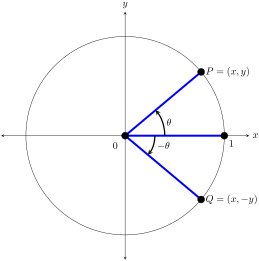
Proof. Let
\(P\) be a point on the unit circle corresponding to the angle
\(\theta\) with coordinates
\((x,y)\) and
\(Q\) be the point corresponding to the angle
\(-\theta\) with coordinates
\((x,-y)\text{.}\)
\begin{align*}
\sin\theta\amp =y, \amp \sin(-\theta)\amp =-y, \amp \cos\theta\amp =x, \amp \cos(-\theta)\amp =x\text{.}
\end{align*}
So
\begin{align*}
\sin(-\theta)\amp =-y=-\sin\theta,\amp \cos(-\theta)\amp =x=\cos\theta\text{.}
\end{align*}
Thus we conclude that sine is an odd function and cosine is an even function. Next, using the Quotient (
Definition 1.4.3 ) and Reciprocal Identities (
Definition 1.4.2 ) we get
\begin{align*}
\tan(-\theta)\amp =\frac{\sin(-\theta)}{\cos(-\theta)}=\frac{-\sin\theta}{\cos\theta}=-\tan\theta,\\
\cot(-\theta)\amp =\frac{1}{\tan(-\theta)}=\frac{1}{-\tan\theta}=-\cot\theta,\\
\csc(-\theta)\amp =\frac{1}{\sin(-\theta)}=\frac{1}{-\sin\theta}=-\csc\theta,\\
\sec(-\theta)\amp =\frac{1}{\cos(-\theta)}=\frac{1}{-\cos\theta}=\sec\theta\text{.}
\end{align*}
Thus tangent, cotangent, cosecant are odd functions and secant is an even function.
Example 1.5.23 .
Use the even-odd properties of trigonometric functions to determine the exact value of:
(a)
Solution .
Since cosecant is an odd function, the cosecant of a negative angle has the opposite sign of the cosecant of the positive angle. Thus,
\(\csc(-30^{\circ})=-\csc30^{\circ}=-2\text{.}\)
(b)
\(\cos(-\theta)\) if
\(\cos\theta=0.4\)
Solution .
Cosine is an even function so
\(\cos(-\theta)=\cos\theta=0.4\text{.}\)
Exercises 1.5.8 Exercises
Exercise Group.
Determine the quadrant containing
\(\theta\) given the following:
1.
\(\cot \theta \lt 0\) and
\(\cos \theta \lt 0\)
2.
\(\csc \theta \gt 0\) and
\(\tan \theta \gt 0\)
3.
\(\cos \theta \gt 0\) and
\(\sin \theta \lt 0\)
4.
\(\sec \theta \gt 0\) and
\(\tan \theta \gt 0\)
5.
\(\tan \theta \lt 0\) and
\(\csc \theta \gt 0\)
6.
\(\cot \theta \gt 0\) and
\(\sin \theta \lt 0\)
7.
\(\sec \theta \lt 0\) and
\(\csc \theta \lt 0\)
8.
\(\cos \theta \lt 0\) and
\(\tan \theta \gt 0\)
Exercise Group.
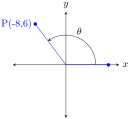
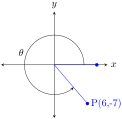
The point
\(P(x,y)\) is on the terminal side of angle
\(\theta\text{.}\) Determine the exact values of the six trigonometric functions at
\(\theta\text{.}\)
9.
Answer .
\(\sin\theta=\frac{3}{5}\text{,}\) \(\cos\theta=-\frac{4}{5}\text{,}\) \(\tan\theta=-\frac{3}{4}\text{,}\) \(\csc\theta=\frac{5}{3}\text{,}\) \(\sec\theta=-\frac{5}{4}\text{,}\) \(\cot\theta=-\frac{4}{3}\)
10.
Answer .
\(\sin\theta=-\frac{7}{\sqrt{85}}\text{,}\) \(\cos\theta=\frac{6}{\sqrt{85}}\text{,}\) \(\tan\theta=-\frac{7}{6}\text{,}\) \(\csc\theta=-\frac{\sqrt{85}}{7}\text{,}\) \(\sec\theta=\frac{\sqrt{85}}{6}\text{,}\) \(\cot\theta=-\frac{6}{7}\)
11.
Answer .
\(\sin\theta=-\frac{4}{5}\text{,}\) \(\cos\theta=\frac{3}{5}\text{,}\) \(\tan\theta=-\frac{4}{3}\text{,}\) \(\csc\theta=-\frac{5}{4}\text{,}\) \(\sec\theta=\frac{5}{3}\text{,}\) \(\cot\theta=-\frac{3}{4}\)
12.
Answer .
\(\sin\theta=-\frac{5}{13}\text{,}\) \(\cos\theta=-\frac{12}{13}\text{,}\) \(\tan\theta=\frac{5}{12}\text{,}\) \(\csc\theta=-\frac{13}{5}\text{,}\) \(\sec\theta=-\frac{13}{12}\text{,}\) \(\cot\theta=\frac{12}{5}\)
13.
Answer .
\(\sin\theta=-\frac{3}{\sqrt{13}}\text{,}\) \(\cos\theta=-\frac{2}{\sqrt{13}}\text{,}\) \(\tan\theta=\frac{3}{2}\text{,}\) \(\csc\theta=-\frac{\sqrt{13}}{3}\text{,}\) \(\sec\theta=-\frac{\sqrt{13}}{2}\text{,}\) \(\cot\theta=\frac{2}{3}\)
14.
Answer .
\(\sin\theta=\frac{1}{\sqrt{2}}\text{,}\) \(\cos\theta=-\frac{1}{\sqrt{2}}\text{,}\) \(\tan\theta=-1\) \(\csc\theta=\sqrt{2}\text{,}\) \(\sec\theta=-\sqrt{2}\text{,}\) \(\cot\theta=-1\)
15.
Answer .
\(\sin\theta=\frac{7}{25}\text{,}\) \(\cos\theta=-\frac{24}{25}\text{,}\) \(\tan\theta=-\frac{7}{24}\text{,}\) \(\csc\theta=\frac{25}{7}\text{,}\) \(\sec\theta=-\frac{25}{24}\text{,}\) \(\cot\theta=-\frac{24}{7}\)
16.
Answer .
\(\sin\theta=-\frac{40}{41}\text{,}\) \(\cos\theta=\frac{9}{41}\text{,}\) \(\tan\theta=-\frac{40}{9}\text{,}\) \(\csc\theta=-\frac{41}{40}\text{,}\) \(\sec\theta=\frac{41}{9}\text{,}\) \(\cot\theta=-\frac{9}{40}\)
Exercise Group.
Find the exact value of the remaining five trigonometric functions of
\(\theta\) from the given information.
17.
\(\tan\theta=-\frac{12}{5}\text{,}\) \(\theta\) is Quadrant II
Answer .
\(\sin\theta=\frac{12}{13}\text{,}\) \(\cos\theta=-\frac{5}{13}\text{,}\) \(\csc\theta=\frac{13}{12}\text{,}\) \(\sec\theta=-\frac{13}{5}\text{,}\) \(\cot\theta=-\frac{5}{12}\)
18.
\(\cos\theta=\frac{3}{5}\text{,}\) \(\theta\) is Quadrant IV
Answer .
\(\sin\theta=-\frac{4}{5}\text{,}\) \(\tan\theta=-\frac{4}{3}\text{,}\) \(\csc\theta=-\frac{5}{4}\text{,}\) \(\sec\theta=\frac{5}{3}\text{,}\) \(\cot\theta=-\frac{3}{4}\)
19.
\(\csc\theta=\frac{\sqrt{10}}{2}\text{,}\) \(\theta\) is Quadrant II
Answer .
\(\sin\theta=\frac{\sqrt{10}}{5}\text{,}\) \(\cos\theta=-\frac{\sqrt{6}}{\sqrt{10}}\text{,}\) \(\tan\theta=-\frac{\sqrt{6}}{3}\text{,}\) \(\sec\theta=-\frac{\sqrt{10}}{\sqrt{6}}\text{,}\) \(\cot\theta=-\frac{\sqrt{6}}{2}\)
20.
\(\cos\theta=-\frac{5}{8}\text{,}\) \(\theta\) is Quadrant III
Answer .
\(\sin\theta=-\frac{\sqrt{39}}{8}\text{,}\) \(\tan\theta=\frac{\sqrt{39}}{5}\text{,}\) \(\csc\theta=-\frac{8}{\sqrt{39}}\text{,}\) \(\sec\theta=-\frac{8}{5}\text{,}\) \(\cot\theta=\frac{5}{\sqrt{39}}\)
21.
\(\sec\theta=-2\text{,}\) \(\pi\lt \theta\lt \frac{3\pi}{2}\)
Answer .
\(\sin\theta=-\frac{\sqrt{3}}{2}\text{,}\) \(\cos\theta=-\frac{1}{2}\text{,}\) \(\tan\theta=\sqrt{3}\text{,}\) \(\csc\theta=-\frac{2}{\sqrt{3}}\text{,}\) \(\cot\theta=\frac{1}{\sqrt{3}}\)
22.
\(\cot\theta=-\frac{5}{3}\text{,}\) \(\frac{3\pi}{2}\lt \theta\lt 2\pi\)
Answer .
\(\sin\theta=-\frac{3}{\sqrt{34}}\text{,}\) \(\cos\theta=\frac{5}{\sqrt{34}}\text{,}\) \(\tan\theta=-\frac{3}{5}\text{,}\) \(\csc\theta=-\frac{\sqrt{34}}{3}\text{,}\) \(\sec\theta=\frac{\sqrt{34}}{5}\)
23.
\(\cos\theta=\frac{2}{3}\text{,}\) \(0\lt \theta\lt \pi\)
Answer .
\(\sin\theta=\frac{\sqrt{5}}{3}\text{,}\) \(\tan\theta=\frac{\sqrt{5}}{2}\text{,}\) \(\csc\theta=\frac{3}{\sqrt{5}}\text{,}\) \(\sec\theta=\frac{3}{2}\text{,}\) \(\cot\theta=\frac{2}{\sqrt{5}}\)
24.
\(\tan\theta=\frac{7}{4}\text{,}\) \(0\lt \theta\lt \frac{\pi}{2}\)
Answer .
\(\sin\theta=\frac{7}{\sqrt{65}}\text{,}\) \(\cos\theta=\frac{4}{\sqrt{65}}\text{,}\) \(\csc\theta=\frac{\sqrt{65}}{7}\text{,}\) \(\sec\theta=\frac{\sqrt{65}}{4}\text{,}\) \(\cot\theta=\frac{4}{7}\)
25.
\(\csc\theta=\frac{3}{2}\text{,}\) \(\tan\theta\lt 0\)
Answer .
\(\sin\theta=\frac{2}{3}\text{,}\) \(\cos\theta=-\frac{\sqrt{5}}{3}\text{,}\) \(\tan\theta=-\frac{2}{\sqrt{5}}\text{,}\) \(\sec\theta=-\frac{3}{\sqrt{5}}\text{,}\) \(\cot\theta=-\frac{\sqrt{5}}{2}\)
26.
\(\sin\theta=\frac{5}{6}\text{,}\) \(\cot\theta>0\)
Answer .
\(\cos\theta=\frac{\sqrt{11}}{6}\text{,}\) \(\tan\theta=\frac{5}{\sqrt{11}}\text{,}\) \(\csc\theta=\frac{6}{5}\text{,}\) \(\sec\theta=\frac{6}{\sqrt{11}}\text{,}\) \(\cot\theta=\frac{\sqrt{11}}{5}\)
27.
\(\sin\theta=-\frac{15}{17}\text{,}\) \(\cos\theta\lt 0\)
Answer .
\(\cos\theta=-\frac{8}{17}\text{,}\) \(\tan\theta=\frac{15}{8}\text{,}\) \(\csc\theta=-\frac{17}{15}\text{,}\) \(\sec\theta=-\frac{17}{8}\text{,}\) \(\cot\theta=\frac{8}{15}\)
28.
\(\cot\theta=-\frac{1}{3}\text{,}\) \(\sin\theta>0\)
Answer .
\(\sin\theta=\frac{3\sqrt{10}}{10}\text{,}\) \(\cos\theta=-\frac{\sqrt{10}}{10}\text{,}\) \(\tan\theta=-3\text{,}\) \(\csc\theta=\frac{\sqrt{10}}{3}\text{,}\) \(\sec\theta=-\sqrt{10}\)
Exercise Group.
Given a reference angle,
\(t'\text{,}\) calculate the corresponding angle,
\(t\text{,}\) in standard position, along with the values of
\(\sin t\text{,}\) \(\cos t\text{,}\) and
\(\tan t\) for:
29.
Answer 1 .
\(t=\frac{3\pi}{4}\text{,}\) \(\sin\frac{3\pi}{4}=\frac{1}{\sqrt{2}}\text{,}\) \(\cos\frac{3\pi}{4}=-\frac{1}{\sqrt{2}}\text{,}\) \(\tan\frac{3\pi}{4}=-1\)
Answer 2 .
\(t=\frac{5\pi}{4}\text{,}\) \(\sin\frac{5\pi}{4}=-\frac{1}{\sqrt{2}}\text{,}\) \(\cos\frac{5\pi}{4}=-\frac{1}{\sqrt{2}}\text{,}\) \(\tan\frac{5\pi}{4}=1\)
Answer 3 .
\(t=\frac{7\pi}{4}\text{,}\) \(\sin\frac{7\pi}{4}=-\frac{1}{\sqrt{2}}\text{,}\) \(\cos\frac{7\pi}{4}=\frac{1}{\sqrt{2}}\text{,}\) \(\tan\frac{7\pi}{4}=-1\)
30.
Answer 1 .
\(t=\frac{2\pi}{3}\text{,}\) \(\sin\frac{2\pi}{3}=\frac{\sqrt{3}}{2}\text{,}\) \(\cos\frac{2\pi}{3}=-\frac{1}{2}\text{,}\) \(\tan\frac{2\pi}{3}=-\sqrt{3}\)
Answer 2 .
\(t=\frac{4\pi}{3}\text{,}\) \(\sin\frac{4\pi}{3}=-\frac{\sqrt{3}}{2}\text{,}\) \(\cos\frac{4\pi}{3}=-\frac{1}{2}\text{,}\) \(\tan\frac{4\pi}{3}=\sqrt{3}\)
Answer 3 .
\(t=\frac{5\pi}{3}\text{,}\) \(\sin\frac{5\pi}{3}=-\frac{\sqrt{3}}{2}\text{,}\) \(\cos\frac{5\pi}{3}=\frac{1}{2}\text{,}\) \(\tan\frac{5\pi}{3}=-\sqrt{3}\)
31.
Answer 1 .
\(t=150^{\circ}\text{,}\) \(\sin150^{\circ}=\frac{1}{2}\text{,}\) \(\cos150^{\circ}=-\frac{\sqrt{3}}{2}\text{,}\) \(\tan150^{\circ}=-\frac{1}{\sqrt{3}}\)
Answer 2 .
\(t=210^{\circ}\text{,}\) \(\sin210^{\circ}=-\frac{1}{2}\text{,}\) \(\cos210^{\circ}=-\frac{\sqrt{3}}{2}\text{,}\) \(\tan210^{\circ}=\frac{1}{\sqrt{3}}\)
Answer 3 .
\(t=330^{\circ}\text{,}\) \(\sin330^{\circ}=-\frac{1}{2}\text{,}\) \(\cos330^{\circ}=\frac{\sqrt{3}}{2}\text{,}\) \(\tan330^{\circ}=-\frac{1}{\sqrt{3}}\)
32.
Answer 1 .
\(t=120^{\circ}\text{,}\) \(\sin120^{\circ}=\frac{\sqrt{3}}{2}\text{,}\) \(\cos120^{\circ}=-\frac{1}{2}\text{,}\) \(\tan120^{\circ}=-\sqrt{3}\)
Answer 2 .
\(t=240^{\circ}\text{,}\) \(\sin240^{\circ}=-\frac{\sqrt{3}}{2}\text{,}\) \(\cos240^{\circ}=-\frac{1}{2}\text{,}\) \(\tan240^{\circ}=\sqrt{3}\)
Answer 3 .
\(t=300^{\circ}\text{,}\) \(\sin300^{\circ}=-\frac{\sqrt{3}}{2}\text{,}\) \(\cos300^{\circ}=\frac{1}{2}\text{,}\) \(\tan300^{\circ}=-\sqrt{3}\)
Exercise Group.
For each angle
\(\theta\text{,}\)
determine the quadrant in which
\(\theta\) lies;
calculate the reference angle
\(\theta'\text{;}\)
use the reference angle,
\(\theta'\text{,}\) to evaluate the exact values of the six trigonometric functions for
\(\theta\text{.}\)
33.
\(\theta=-\frac{3\pi}{4}\)
Answer 1 . Answer 2 .
\(\theta'=\frac{\pi}{4}\)
Answer 3 .
\(\sin\theta=-\frac{1}{\sqrt{2}}\text{,}\) \(\cos\theta=-\frac{1}{\sqrt{2}}\text{,}\) \(\tan\theta=1\text{,}\) \(\csc\theta=-\sqrt{2}\text{,}\) \(\sec\theta=-\sqrt{2}\text{,}\) \(\cot\theta=1\)
34.
\(\theta=\frac{4\pi}{3}\)
Answer 1 . Answer 2 .
\(\theta'=\frac{\pi}{3}\)
Answer 3 .
\(\sin\theta=-\frac{\sqrt{3}}{2}\text{,}\) \(\cos\theta=-\frac{1}{2}\text{,}\) \(\tan\theta=\sqrt{3}\text{,}\) \(\csc\theta=-\frac{2}{\sqrt{3}}\text{,}\) \(\sec\theta=-2\text{,}\) \(\cot\theta=\frac{1}{\sqrt{3}}\)
35.
\(\theta=\frac{11\pi}{6}\)
Answer 1 . Answer 2 .
\(\theta'=\frac{\pi}{6}\)
Answer 3 .
\(\sin\theta=-\frac{1}{2}\text{,}\) \(\cos\theta=\frac{\sqrt{3}}{2}\text{,}\) \(\tan\theta=-\frac{1}{\sqrt{3}}\text{,}\) \(\csc\theta=-2\text{,}\) \(\sec\theta=\frac{2}{\sqrt{3}}\text{,}\) \(\cot\theta=-\sqrt{3}\)
36.
\(\theta=\frac{7\pi}{3}\)
Answer 1 . Answer 2 .
\(\theta'=\frac{\pi}{3}\)
Answer 3 .
\(\sin\theta=\frac{\sqrt{3}}{2}\text{,}\) \(\cos\theta=\frac{1}{2}\text{,}\) \(\tan\theta=\sqrt{3}\text{,}\) \(\csc\theta=\frac{2}{\sqrt{3}}\text{,}\) \(\sec\theta=2\text{,}\) \(\cot\theta=\frac{1}{\sqrt{3}}\)
37.
Answer 1 . Answer 2 . Answer 3 .
\(\sin\theta=\frac{\sqrt{3}}{2}\text{,}\) \(\cos\theta=-\frac{1}{2}\text{,}\) \(\tan\theta=-\sqrt{3}\text{,}\) \(\csc\theta=\frac{2}{\sqrt{3}}\text{,}\) \(\sec\theta=-2\text{,}\) \(\cot\theta=-\frac{1}{\sqrt{3}}\)
38.
Answer 1 . Answer 2 . Answer 3 .
\(\sin\theta=\frac{\sqrt{3}}{2}\text{,}\) \(\cos\theta=-\frac{1}{2}\text{,}\) \(\tan\theta=-\sqrt{3}\text{,}\) \(\csc\theta=\frac{2}{\sqrt{3}}\text{,}\) \(\sec\theta=-2\text{,}\) \(\cot\theta=-\frac{1}{\sqrt{3}}\)
Exercise Group.
Use the fact that the trigonometric functions are periodic to find the exact value for each expression.
39. 40. 41. 42. 43. 44. 45. 46.
47. Prove the second Pythagorean Identity (
Definition 1.5.20 ):
\(1+\tan^2\theta=\sec^2\theta.\)
Hint .
Begin with
\(\sin^2\theta+\cos^2\theta=1\) and divide both sides of the equation by
\(\cos^2\theta.\)
48. Prove the third Pythagorean Identity (
Definition 1.5.20 ):
\(1+\cot^2\theta=\csc^2\theta.\)
Hint .
Begin with
\(\sin^2\theta+\cos^2\theta=1\) and divide both sides of the equation by
\(\sin^2\theta\text{.}\)
Exercise Group.
Use the Pythagorean Identity to find the exact value of the following:
49.
\(\sin^238^{\circ}+\cos^238^{\circ}\)
50.
\(\csc^213^{\circ}-\cot^213^{\circ}\)
51.
\(\cot^2200^{\circ}-\csc^2200^{\circ}\)
52.
\(\sec^2\frac{6\pi}{5}-\tan^2\frac{6\pi}{5}\)
53.
\(\tan^2\frac{5\pi}{7}-\sec^2\frac{5\pi}{7}\)
54.
\(\sin^2\frac{14\pi}{13}+\cos^2\frac{14\pi}{13}\)
Exercise Group.
Use the Pythagorean Identities to express the first trigonometric function of
\(\theta\) in terms of the second function, given the quadrant.
55.
\(\sin\theta\text{,}\) \(\cos\theta\text{,}\) Quadrant III
Answer .
\(\sin\theta=-\sqrt{1-\cos^2\theta}\)
56.
\(\cos\theta\text{,}\) \(\sin\theta\text{,}\) Quadrant II
Answer .
\(\cos\theta=-\sqrt{1-\sin^2\theta}\)
57.
\(\tan\theta\text{,}\) \(\sec\theta\text{,}\) Quadrant IV
Answer .
\(\tan\theta=-\sqrt{\sec^2\theta-1}\)
58.
\(\cot\theta\text{,}\) \(\csc\theta\text{,}\) Quadrant III
Answer .
\(\cot\theta=\sqrt{\csc^2\theta-1}\)
59.
\(\tan\theta\text{,}\) \(\sin\theta\text{,}\) Quadrant III
Answer .
\(\tan\theta=-\frac{\sin\theta}{\sqrt{1-\sin^2\theta}}\)
60.
\(\tan\theta\text{,}\) \(\cos\theta\text{,}\) Quadrant II
Answer .
\(\tan\theta=\frac{\sqrt{1-\cos^2\theta}}{\cos\theta}\)
Exercise Group.
Use the Pythagorean Identities to find the exact values of the remaining five trigonometric functions of
\(\theta\) from the given information.
61.
\(\tan\theta=-\frac{4}{3}\text{,}\) \(\theta\) is in Quadrant IV
Answer .
\(\sin\theta=-\frac{4}{5}\text{,}\) \(\cos\theta=\frac{3}{5}\text{,}\) \(\csc\theta=-\frac{5}{4}\text{,}\) \(\sec\theta=\frac{5}{3}\text{,}\) \(\cot\theta=-\frac{3}{4}\)
62.
\(\cos\theta=-\frac{1}{4}\text{,}\) \(\theta\) is in Quadrant II
Answer .
\(\sin\theta=\frac{\sqrt{15}}{4}\text{,}\) \(\tan\theta=-\sqrt{15}\text{,}\) \(\csc\theta=\frac{4}{\sqrt{15}}\text{,}\) \(\sec\theta=-4\text{,}\) \(\cot\theta=-\frac{1}{\sqrt{15}}\)
63.
\(\sin\theta=-\frac{2}{3}\text{,}\) \(\theta\) is in Quadrant III
Answer .
\(\cos\theta=-\frac{\sqrt{5}}{3}\text{,}\) \(\tan\theta=\frac{2}{\sqrt{5}}\text{,}\) \(\csc\theta=-\frac{3}{2}\text{,}\) \(\sec\theta=-\frac{3}{\sqrt{5}}\text{,}\) \(\cot\theta=\frac{\sqrt{5}}{2}\)
64.
\(\cos\theta=\frac{3}{5}\text{,}\) \(\theta\) is in Quadrant IV
Answer .
\(\sin\theta=-\frac{4}{5}\text{,}\) \(\tan\theta=-\frac{4}{3}\text{,}\) \(\csc\theta=-\frac{5}{4}\text{,}\) \(\sec\theta=\frac{5}{3}\text{,}\) \(\cot\theta=-\frac{3}{4}\)
Exercise Group.
Use the even and odd properties to evaluate the following:
65. 66. 67. 68. 69. 70. 71.
\(\sin\left(-\frac{11\pi}{6}\right)\)
72.
\(\tan\left(-\frac{5\pi}{4}\right)\)
73.
\(\cos\left(-\frac{4\pi}{3}\right)\)
74. 75.
\(\sec\left(-\frac{\pi}{4}\right)\)
76.
\(\csc\left(-\frac{7\pi}{6}\right)\)
Exercise Group.
In
Remark 1.5.9 , we learned that if the reference angle is given in radians and has the form
\(t'=\frac{a\pi}{b}\text{,}\) then the corresponding angle in standard position,
\(t\text{,}\) can be determined using an equation.
77.
Prove that if \(t\) is in Quadrant II, then
\begin{equation*}
t=\frac{(b-a)\pi}{b}\text{.}
\end{equation*}
78.
Prove that if \(t\) is in Quadrant III, then
\begin{equation*}
t=\frac{(b+a)\pi}{b}\text{.}
\end{equation*}
79.
Prove that if \(t\) is in Quadrant IV, then
\begin{equation*}
t=\frac{2(b-a)\pi}{b}\text{.}
\end{equation*}
Exercise Group.
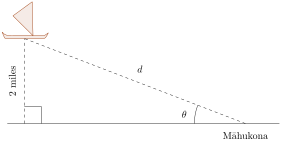
The Makaliʻi is sailing along the Kohala Coast, maintaining a distance of two nautical miles from the shore. An observer at Māhukona is monitoring Makaliʻi’s passage. Let
\(d\) denote the length of the line connecting Makali‘i to the Māhukona observer. Given
\(\theta\) as the angle formed between
\(d\) and the shore, determine Makali‘i’s distance,
\(d\text{,}\) from the observer for each value of
\(\theta\text{,}\) rounded to one decimal place.
80. 81. 82. 83. 84. 85. 86.