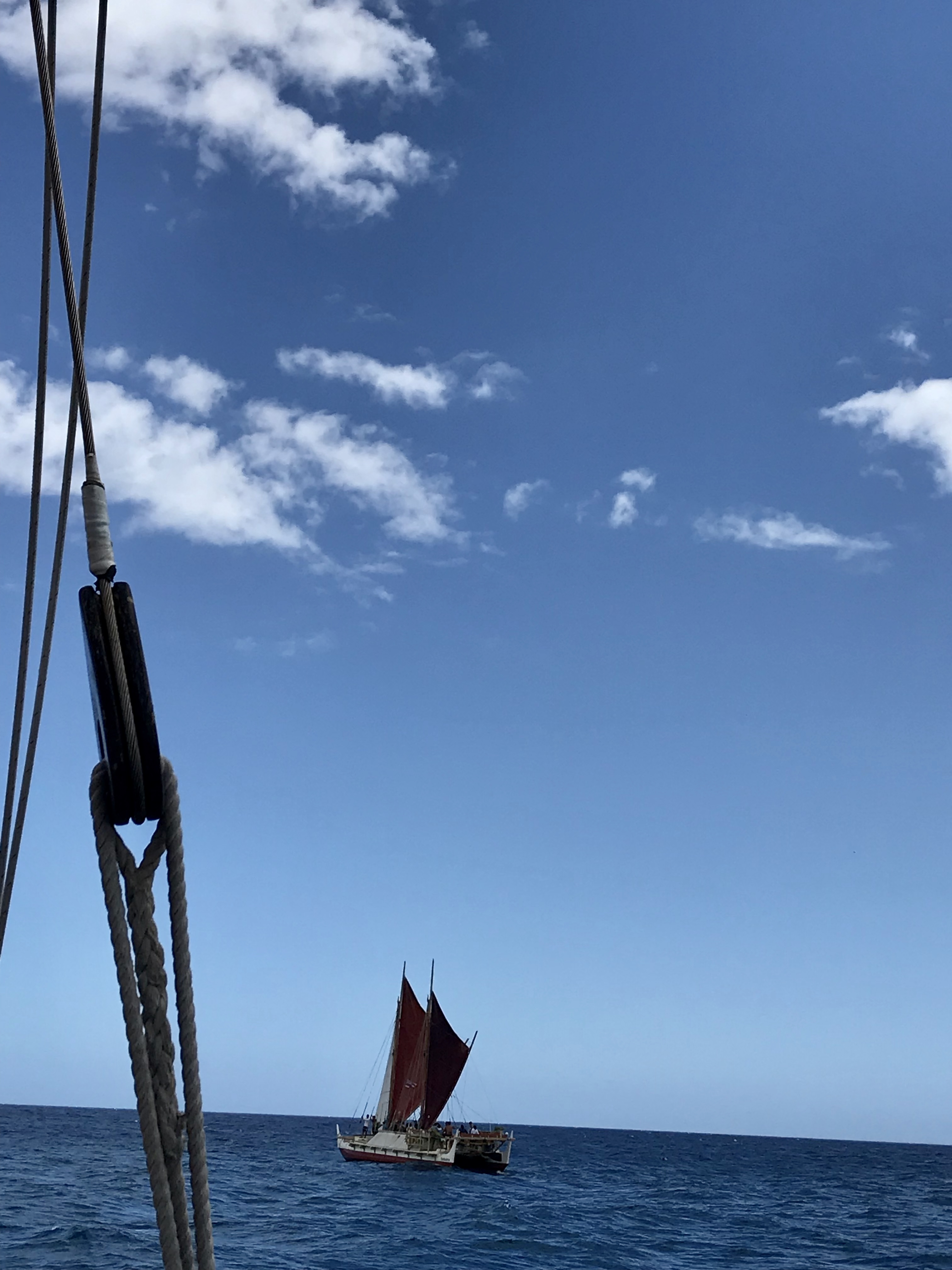
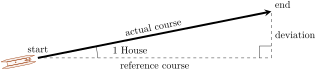
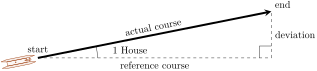
During a voyage, a navigator utilizes a reference course —a line connecting the starting point and destination—to monitor their position. When the waʻa (canoe) encounters winds that veer it off course, the navigator mentally plots their position relative to the reference course. To ensure the destination isn’t missed, navigators must monitor their deviation from the intended course, involving measurement of the angle of deviation from the reference course (in units of houses) and determining the distance traveled. This section explores the calculation of trigonometric functions using right triangles, enabling us to assess how much the waʻa has strayed from its intended reference course.
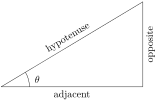
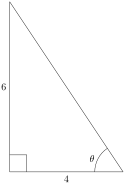
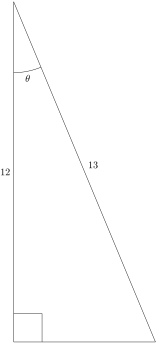
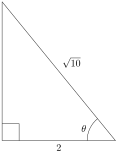
A common mnemonic for remembering these relationships is SOHCAHTOA, formed from the first letters of “Sine is Opposite over Hypotenuse, Cosine is Adjacent over Hypotenuse, Tangent is Opposite over Adjacent.”
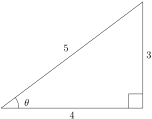
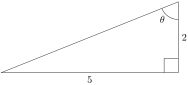
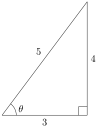
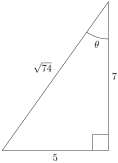
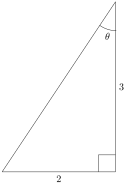
Notice that \(\theta\) is in a different position. Here, the adjacent side is three and the opposite side is five. If we let \(h\) denote the hypotenuse, then we can use the Pythagorean Theorem to get
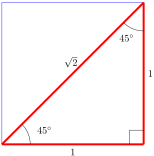
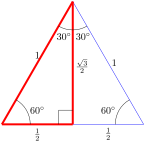
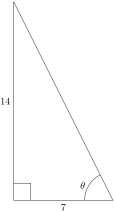
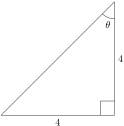
The angles \(30^{\circ}, 45^{\circ}, 60^{\circ}\) (\(\frac{\pi}{6}, \frac{\pi}{4}, \frac{\pi}{3}\)) give special values for trigonometric functions. The following figures are used to calculate trigonometric values.
The trigonometric values for the special angles \(0^{\circ}, 30^{\circ}, 45^{\circ}, 60^{\circ}, 90^{\circ}\)\(\left(0, \frac{\pi}{6}, \frac{\pi}{4}, \frac{\pi}{3}, \frac{\pi}{2}\right)\) are given in Table 1.4.6.
The symmetry between \(\sin\theta\) and \(\cos\theta\) becomes evident when reversing the order of sine and cosine values from \(90^{\circ}\) to \(0^{\circ}\text{.}\) This symmetry yields \(\sin0^{\circ}=\cos90^{\circ}\text{,}\)\(\sin30^{\circ}=\cos60^{\circ}\text{,}\)\(\sin45^{\circ}=\cos45^{\circ}\text{,}\)\(\sin60^{\circ}=\cos30^{\circ}\text{,}\) and \(\sin90^{\circ}=\cos0^{\circ}\text{.}\)
This pattern between sine and cosine is no coincidence; it emerges because the three angles in a triangle add up to \(180^{\circ}\) or \(\pi\) radians. When considering a right triangle, the remaining two angles combine to form \(90^{\circ}\) or \(\frac{\pi}{2}\) radians, making them complementary angles.
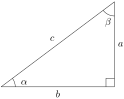
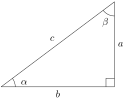
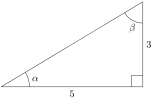
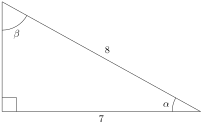
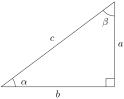
Consider the right triangle in the figure above, where angles \(\alpha\) and \(\beta\) are complementary angles. Side \(a\) is opposite of angle \(\alpha\text{,}\) and side \(b\) is opposite of angle \(\beta\text{.}\) Notice that we can also describe side \(b\) as adjacent to angle \(\alpha\) and side \(a\) as adjacent to angle \(\beta\text{.}\) Therefore,
Sine and cosine are called cofunctions because of this relationship between these functions and their complementary angles. We can obtain similar relationships for all trigonometric functions:
Since \(\alpha\) and \(\beta\) are complementary angles, \(\alpha+\beta=90^{\circ}\text{.}\) Rearranging, we get \(\beta=90^{\circ}-\alpha\text{.}\) Substituting this into our cofunctions and replacing \(\alpha\) with \(\theta\text{,}\) we get our cofunction identities.
First, ensure that the angle is either in degrees or radians, depending on the problem. Refer to your calculator’s manual for instructions. Most calculators have dedicated buttons for the sine, cosine, and tangent functions. Depending on your calculator, you may see the following keys
Answers produced by calculators are estimates and we should pay close attention to see if the question is asking for the exact solution or a decimal approximation. For example, if we need to calculate \(\sin45^{\circ}=\frac{1}{\sqrt{2}}\text{,}\) the calculator may give the answer as \(\sin45^{\circ}\approx0.70710678\text{,}\) which is a decimal approximation since the actual value is an irrational number with infinitely many decimal places. Unless stated otherwise, answers in the book should be exact, e.g. \(\frac{1}{\sqrt{2}}\) and not 0.70710678.
Before proceeding, we confirm that our calculator is set to either degree or radian mode. Additionally, for the sake of simplicity, we will round our answers to four decimal places.
Observe that \(\cos5^{\circ}\neq\cos5\mbox{ rad}\text{.}\) This emphasizes the significance of verifying whether the calculator is in degree or radian mode.
Consider the following right triangle where side \(a\) is opposite angle \(\alpha\text{,}\) side \(b\) is opposite angle \(\beta\text{,}\) and side \(c\) is the hypotenuse. Since \(\alpha\) and \(\beta\) are complementary angles, we have
To solve a triangle is the process of determining the values for all three lengths of its sides and the measures of all three angles, based on provided information about the triangle.
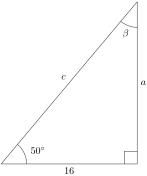
Given that this is a right triangle, we already know one angle is \(90^{\circ}\text{,}\) and we have an additional angle of \(50^{\circ}\) along with an adjacent side length of 16. To solve this triangle, we need to determine the values of sides \(a\text{,}\)\(c\text{,}\) and \(\beta\text{.}\) We begin by finding the measure of angle \(\beta\text{.}\) Since \(50^{\circ}+\beta=90^{\circ}\) we have
Next, we will solve for side \(a\text{.}\) Using the angle \(50^{\circ}\text{,}\) where the adjacent side is 16 and side \(a\) is the side opposite to the angle, we can apply the tangent function, which relates the opposite and adjacent sides:
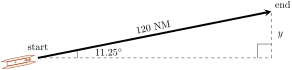
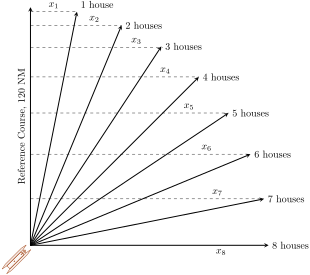
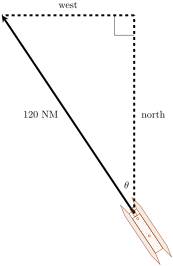
We are now ready to calculate the deviation example proposed at the start of this section. In an average day of sailing, a waʻa sails 120 nautical miles (NM). If Hikianalia is supposed to sail in the direction of Hikina (East), but currents have deviated her course by one house so she actually sailed in the house Lā, how far off the course has Hikianalia deviated?
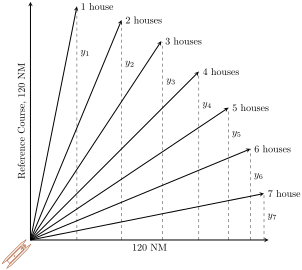
From the Star Compass (Figure 1.1.4), the house Lā is one house (\(11.25^{\circ}\)) from Hikina. If we let \(y\) denote the distance deviated from the reference course, our right triangle becomes:
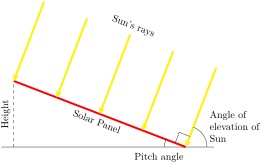
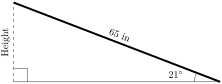
Solar panels harness the sun’s energy to generate electricity, and for optimal energy output, they should be oriented perpendicularly to the sun’s light. The sun’s angle of elevation varies based on latitude, and in Hawai‘i, for instance, south-facing solar panels are recommended to have a pitch of \(21^{\circ}\) to align with the sun’s rays. When installing a solar panel, determining its pitch might pose challenges. Instead of measuring the angle directly, an alternative approach involves measuring the height of the panel’s top. What height should a south-facing solar panel, measuring 65 inches in length, be installed at to achieve the desired angle of \(21^{\circ}\text{?}\) Round your answer to the nearest tenth of an inch.
Thus, when installing a solar panel in Hawai‘i, the top of the solar panel should be positioned 23.3 inches above the bottom to optimize energy output.
In Example 1.4.15, we determined that when a wa‘a sails for one day (120 nautical miles) and deviates from its course by 1 house, the resulting deviation from the reference course is \(23.4\) NM. Now, calculate the deviations (\(x\)) for the remaining 7 angles. Round your answer to the nearest tenth of a nautical mile. Remember that one house corresponds to \(11.25^{\circ}\text{.}\)
In Exercise 1.4.7.17–23 we determined the deviation of a wa‘a following a day of sailing (120 nautical miles). Your task now is to calculate the distance the wa‘a has progressed along the reference course (north) for each deviation, denoted as \(y\text{.}\) Round your answer to the nearest tenth of a nautical mile and remember that one house corresponds to \(11.25^{\circ}\text{.}\)
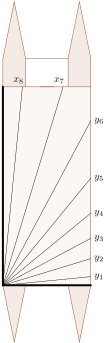
One way to determine our bearing on a canoe is by observing and comparing the positions of celestial and other markers relative to our canoe. To facilitate this, we can mark the locations of the Star Compass on the opposite railings from the navigator’s seat in the back corner of the canoe. However, since the Star Compass is circular and the canoe is rectangular, accurately placing the markings can be challenging.
When the navigator occupies the port stern (back left) corner of the deck, markers indicating the boundaries between houses can be placed on the corresponding railings on the bow (front) and starboard (right) sides of the canoe. For each value of \(\theta\text{,}\) calculate the distance along the starboard railing (\(y\)) or bow railing (\(x\)) for a canoe with dimensions \(l=50\) ft and \(w=20\) ft. Round your answers to three decimal places.
A waʻa sails in the direction of the house Nālani Hoʻolua for one day, covering 120 nautical miles. How many nautical miles has the waʻa traveled north? How many miles has the waʻa traveled west? To calculate the angle \(\theta\text{,}\) refer to the Star Compass (Figure 1.1.4) to determine the number of houses, and use the fact that one house is \(11.25^{\circ}\text{.}\)
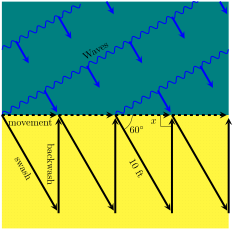
The movement of sand on a beach is a dynamic process influenced by various factors, such as waves. When waves approach the shore at an angle, they lead to the shifting of sand. During the swash phase, as the wave crashes onto the shore, water and sediment move onto the beach following the wave’s angle. Subsequently, gravity propels the water and sediment back into the ocean, perpendicular to the shoreline, in a process known as backwash. This interplay of swash and backwash creates a zig-zag pattern called longshore drift.
Certain beaches undergo seasonal changes in wave direction. Some experience waves from one direction in one season and from another direction in the next, while those receiving waves predominantly from a single direction might accumulate sand in specific areas.
Calculate how far along the shore a single grain of sand moves after a wave breaks at a \(60^{\circ}\) angle and travels onto the shore for 10 ft before receding back into the ocean.
Between 2013 and 2017, Hōkūleʻa completed a global circumnavigation with a mission mālama honua - “care for our Earth” and to foster a sense of ʻohana (“family”) for all people and places. This remarkable voyage spanned 40,000 nautical miles and made stops at over 150 ports across 18 nations.
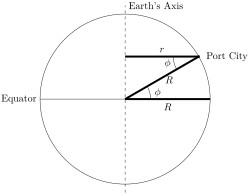
Throughout this voyage, Earth’s rotation occurs around an axis that extends from the North Pole to the South Pole. The rotation imparts an angular speed and linear velocity to every point on Earth. Assuming Earth completes one rotation within 24 hours and treating Earth as a perfect sphere with a radius of \(R=4,000\) miles, we can calculate the following parameters for each of the Mālama Honua Voyage’s ports, given their latitudes (\(\phi\)).