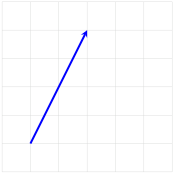
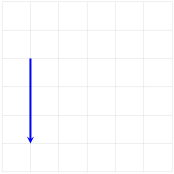
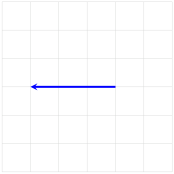
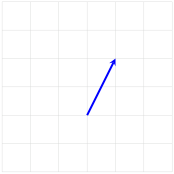
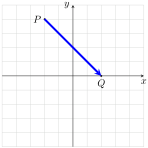
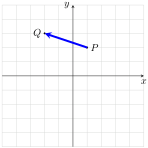
In Section 4.3, we visualized vectors as directed line segments with magnitudes and direction. Now, we will explore vectors through a coordinate approach, where we express vectors in terms of their components along the coordinate axes .
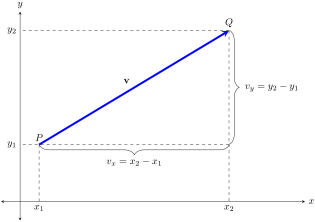
A vector \(\mathbf{v}\) with initial point \(P(x_1,y_1)\) and terminal point \(Q(x_2,y_2)\) can be expressed in various ways. One common representation is as the directed line segment from point \(P\) to point \(Q\text{,}\) denoted as \(\overrightarrow{PQ}\text{.}\) Alternatively, we can describe it using the changes in the \(x-\) and \(y-\) coordinates between points \(P\) and \(Q\text{.}\) These changes are referred to as the horizontal component and vertical component of the vector, denoted as \(v_x\) and \(v_y\) respectively. Mathematically, these representations are all equivalent:
To avoid confusion with the notation for a point and an interval, we use the symbol \(\langle v_1,v_2\rangle\) for an ordered pair that represents a vector in component form. Lowercase letters are used to represent the components.
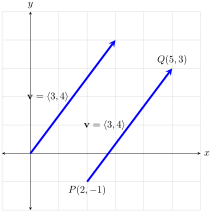
The position vector represents the terminal point of any vector \(\mathbf{v}\) when its initial point is at the origin. Essentially, it is \(\mathbf{v}\) translated so that its initial point is at the origin. This translation does not change the magnitude or direction, making the two vectors equivalent. Thus, we can refer to both vectors as \(\mathbf{v}\text{.}\) In other words, the terminal point of a vector starting at the origin is defined by its horizontal and vertical components.
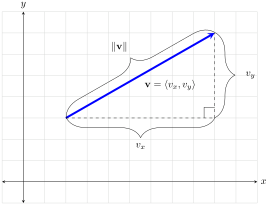
This formula is derived from the Pythagorean Theorem or the distance formula where the square of the magnitude equals the square of the horizontal component plus the square of the vertical component:
Subsection4.4.2Properties of Addition, Length, and Scalar Multiplication
Definition4.4.13.Properties of Vectors.
If \(\mathbf{u}\text{,}\)\(\mathbf{v}\text{,}\) and \(\mathbf{w}\) are vectors, \(\mathbf{0}\) is the zero vector, and \(c\) and \(d\) are scalars, then:
Sometimes it is useful to look at problems involving vectors in terms of a vector in the same direction, but with a magnitude of one. Recall that a unit vector \(\mathbf{u}\) is a vector whose length is one, \(\|\mathbf{u}\|=1\text{.}\) To find a unit vector in the same direction, we will need to multiply that vector by the reciprocal of its length or magnitude.
Two useful unit vectors are \(\mathbf{i}\) and \(\mathbf{j}\text{.}\) The vector \(\mathbf{i}\) represents the unit vector whose direction is along the positive \(x\)-axis and the vector \(\mathbf{j}\) represents the unit vector whose direction is along the positive \(y\)-axis.
Recall that a vector is composed of a direction and magnitude. Earlier in this section we learned how to calculate the magnitude. Now we will discuss how to calculate the direction.
Let \(\mathbf{v}=\langle v_x,v_y\rangle\) be a vector. The angle \(\theta\) represents the direction of \(\mathbf{v}\) and is the smallest positive angle in standard position formed by the positive \(x\)-axis and \(\mathbf{v}\) (\(0^{\circ}\leq\theta\lt360^{\circ}\)).
Since \(-90^{\circ} \lt \tan^{-1} \left( \frac{v_y}{v_x} \right) \lt 90^{\circ}\text{,}\) the inverse tangent function returns an angle in Quadrants I or IV. To determine the correct direction \(\theta\text{,}\) consider the quadrant in which the vector lies and make the appropriate adjustments:
Definition4.4.20.Finding Horizontal and Vertical Components of Vectors from Magnitude and Direction.
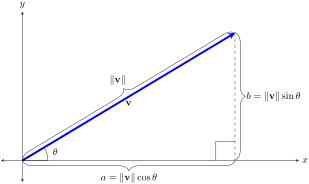
For vector \(\mathbf{v}\) with magnitude \(\|\mathbf{v}\|\) and direction \(\theta\text{,}\) we can use Right Triangle Trigonometry to solve for the horizontal and vertical components, denoted as \(v_x\) and \(v_y\text{,}\) respectively:
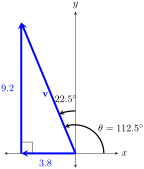
First, we note that since the velocity is 10 knots, we have \(\|\mathbf{v}\|=10\text{.}\) Next, we need to find the direction. Since \(\theta\) is measured from the positive \(x\)-axis, by Definition 4.4.20 we see that
Example4.4.22.Calculating Canoe Velocity with Current Drift.
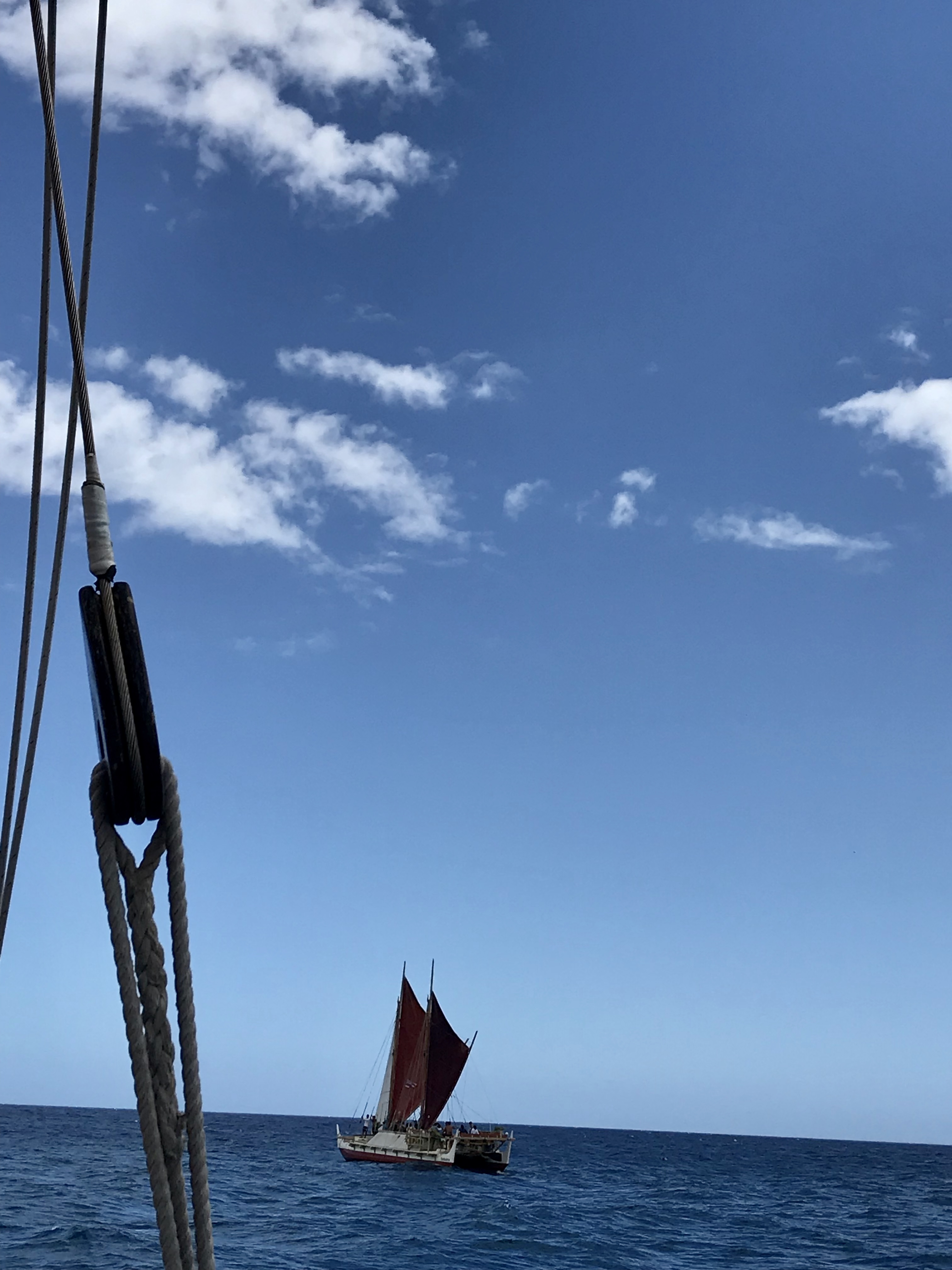
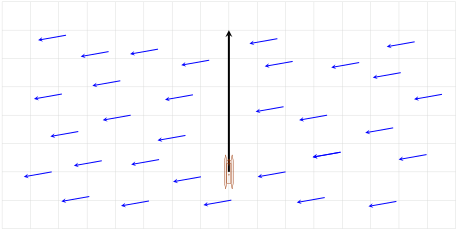
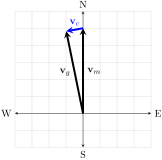
The vaka Marumaru Atua sets sail on a northward voyage from Rarotonga to Hawaiʻi, maintaining a steady speed of 5 knots through the water. However, a 1-knot current flows in the direction of Lā Kona (a heading of 260 degrees). This current’s influence is like walking across a moving floor—no matter how steadily the vaka sails north, the entire ocean beneath it is shifting, altering its actual path. Similarly, Marumaru Atua navigates while the water, in the form of a current, also moves. In sailing, the direction and speed at which the current is pushing the vaka are referred to as set and drift, respectively.
The actual velocity of Marumaru Atua is the resultant of the vaka’s velocity and the current’s velocity. This resultant velocity vector denotes the vaka’s speed and direction relative to fixed objects on Earth, influenced by the current’s impact on Marumaru Atua. The magnitude and direction of this velocity vector are represented by the speed over ground (SOG) and course over ground (COG), respectively. SOG represents the speed of the vaka relative to fixed objects, accounting for both the vaka’s speed through the water and the current’s speed and direction. COG indicates the direction of the vaka’s motion over the Earth’s surface.
Understanding the difference between the velocity over water and the velocity relative to fixed objects illustrates the influence set and drift have on the vaka’s course and speed over ground. Voyagers need to account for set and drift when navigating to ensure they reach their intended destination accurately and safely.
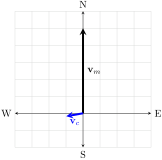
Express Marumaru Atua’s velocity vector, represented as \(\mathbf{v}_m\text{,}\) and the velocity vector of the current, denoted as \(\mathbf{v}_c\text{,}\) in terms of their horizontal and vertical components. Round the answer to two decimal places.
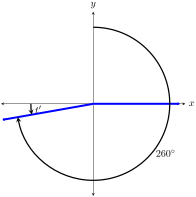
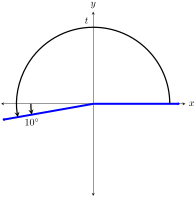
To find the vector for the current, we need to know \(t\text{,}\) the angle of the velocity vector in standard position (see Definition 1.2.8). We begin by drawing the heading angle of \(260^{\circ}\) and its reference angle, \(t'\text{.}\)
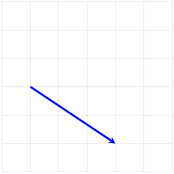
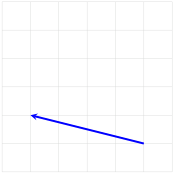
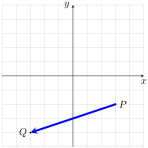
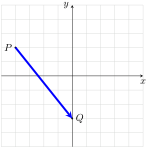
For each of the following, find the vector with initial point at \(P\) and terminal point at \(Q\text{.}\) Express your answer in form \(\langle a,b\rangle\text{.}\)
For given vectors \(\mathbf{u}\) and \(\mathbf{v}\text{,}\) find \(2\mathbf{u}\text{,}\)\(\mathbf{u}+\mathbf{v}\text{,}\)\(\mathbf{u}-\mathbf{v}\text{,}\) and \(3\mathbf{u}+2\mathbf{v}\text{.}\)
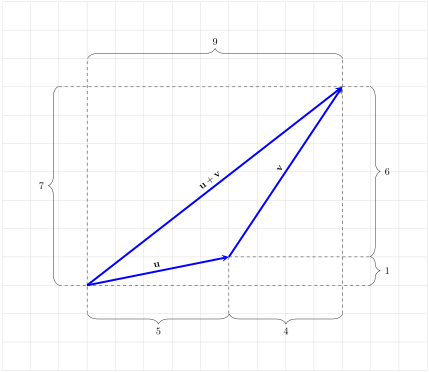
A fundamental property in Euclidean geometry is the Triangle Inequality, which states that for any triangle, the sum of the lengths of any two sides of a triangle is greater than or equal to the length of the remaining side. This property can be illustrated using vectors, where combining vectors \(\mathbf{u}\) and \(\mathbf{v}\) results in a triangle with the third side represented by \(\mathbf{u}+\mathbf{v}\text{,}\) as shown in Figure 4.3.14. The Triangle Inequality is expressed as \(\|\mathbf{u}\|+\|\mathbf{v}\|\geq\|\mathbf{u}+\mathbf{v}\|\text{.}\)
To demonstrate the Triangle Inequality with given vectors \(\mathbf{u}\) and \(\mathbf{v}\text{,}\) calculate the following magnitudes rounded to the nearest tenth: \(\|\mathbf{u}\|\text{,}\)\(\|\mathbf{v}\|\text{,}\)\(\|\mathbf{u}\|+\|\mathbf{v}\|\text{,}\) and \(\|\mathbf{u}+\mathbf{v}\|\text{.}\) Note that to calculate \(\|\mathbf{u}+\mathbf{v}\|\text{,}\) first find the vector \(\mathbf{u}+\mathbf{v}\)
For each problem, the magnitude and direction of vector \(\mathbf{v}\) are given. Find the horizontal and vertical components of the vector, \(v_x \) and \(v_y \text{,}\) respectively, and write the vector in the form \(\mathbf{v} = v_x \mathbf{i} + v_y \mathbf{j} \text{.}\)
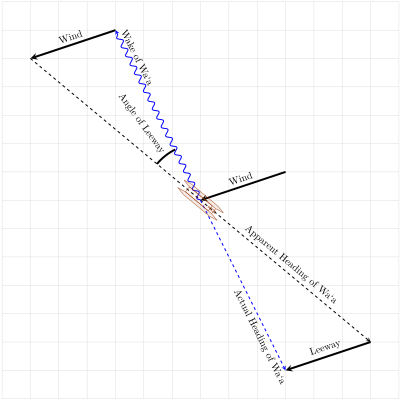
When a waʻa sails on the ocean, it rarely moves precisely in the direction it’s pointed. One reason for this is that crosswind can push the waʻa off its course. The angle of displacement between the apparent heading of the waʻa and the direction the waʻa is actually traveling through the water is referred to as leeway. Using vector addition, we can determine where the waʻa will actually travel. However, on the waʻa, the navigator can determine the leeway by observing the angle between the wake behind the waʻa and the apparent direction the waʻa is pointed towards.
In order to compensate for the wind, the navigator must steer the waʻa into the wind by the same angle as the leeway angle. For example, if the waʻa needs to sail in the house Manu Malanai and the wind is pushing the waʻa one house further south, the waʻa will move in the house Nālani Malanai. To maintain the course in the house Manu Malanai, the navigator must then point the waʻa one house north with an apparent heading in the house of Noio Malanai in order for the actual heading to be in the house of Manu Malanai.
If the apparent heading is represented by the vector \(\langle6,-5\rangle\) and the leeway is represented by the vector \(\langle-3,-1\rangle\text{,}\) calculate the vector for the actual heading.