Skip to main content
Contents Index
Search Book
Search Results:
No results.
Calculator
Read aloud Readability settings Prev Up Next Scratch ActiveCode \(\newcommand{\sectionbreak}{\clearpage}
\usepackage{cancel}
\newcommand{\lt}{<}
\newcommand{\gt}{>}
\newcommand{\amp}{&}
\definecolor{fillinmathshade}{gray}{0.9}
\newcommand{\fillinmath}[1]{\mathchoice{\colorbox{fillinmathshade}{$\displaystyle \phantom{\,#1\,}$}}{\colorbox{fillinmathshade}{$\textstyle \phantom{\,#1\,}$}}{\colorbox{fillinmathshade}{$\scriptstyle \phantom{\,#1\,}$}}{\colorbox{fillinmathshade}{$\scriptscriptstyle\phantom{\,#1\,}$}}}
\)
Section 3.5 Basic Trigonometric Equations
Trigonometric equations are equations involving trigonometric functions such as sine, cosine, and tangent. These equations seek to find specific values, known as
solutions , that satisfy the equation.
Trigonometric functions are inherently periodic, meaning they repeat their values at regular intervals. As a result, trigonometric equations may have multiple solutions due to this periodic nature. In fact, some equations may have infinitely many solutions.
To address all possible solutions, we use a technique known as a
general solution . This method involves initially identifying solutions within a single period of the trigonometric function. We then extend these solutions by adding integer multiples of the period of the trigonometric function.
In this section, we will explore various techniques for effectively solving trigonometric equations, including methods for finding general solutions.
Subsection 3.5.1 Solving Equations with a Single Trigonometric Function
Example 3.5.1 .
Solve the equation
\begin{equation*}
\sin\theta=\frac{1}{2}\text{.}
\end{equation*}
Solution .
To solve the equation \(\sin\theta=\frac{1}{2}\text{,}\) our initial instinct might lead us to take the inverse sine of both sides:
\begin{equation*}
\sin^{-1}\left(\sin\theta\right)=\sin^{-1}\left(\frac{1}{2}\right)
\end{equation*}
resulting in
\begin{equation*}
\theta=\frac{\pi}{6}\text{.}
\end{equation*}
While this is a valid solution, it’s important to recognize that there are additional solutions to consider.
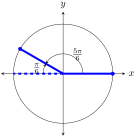
Since the sine function is positive in both Quadrant I and Quadrant II, we can find another solution in Quadrant II by using the reference angle
\(\frac{\pi}{6}\) and the methods described in
Subsection 1.5.2 . Therefore, the equivalent angle in Quadrant II is
\(\theta=\pi-\frac{\pi}{6}=\frac{5\pi}{6}\text{.}\)
However, these two angles,
\(\theta=\frac{\pi}{6}\) or
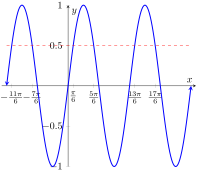
\(\theta=\frac{5\pi}{6}\text{,}\) are not the only solutions. Recall that the sine function has a period of
\(2\pi\text{,}\) meaning that adding or subtracting any integer multiples of
\(2\pi\) to these angles will also give us solutions. For example,
\(\theta=\frac{\pi}{6}+4\pi\) and
\(\theta=\frac{5\pi}{6}-10\pi\) are both solutions.
Thus, the general solution to \(\sin\theta=\frac{1}{2}\) can be expressed as:
\begin{equation*}
\theta=\frac{\pi}{6}+2k\pi\quad\mbox{or}\quad\theta=\frac{5\pi}{6}+2k\pi\text{,}
\end{equation*}
where \(k\) is any integer.
Example 3.5.2 .
Solve the equation
\(2\cos\theta+\sqrt{2}=0\text{.}\) List six solutions.
Solution .
First we will isolate \(\cos\theta\text{.}\)
\begin{align*}
2\cos\theta+\sqrt{2} \amp = 0 \\
2\cos\theta \amp = -\sqrt{2} \\
\cos\theta \amp = -\frac{\sqrt{2}}{2} \text{.}
\end{align*}
Thus we have the general solution
\(\theta=\frac{3\pi}{4}+2k\pi\) or
\(\theta=\frac{5\pi}{4}+2k\pi\) for any integer
\(k\text{.}\)
To get specific solutions, we select specific values of \(k\text{:}\)
\begin{align*}
k=-1: \amp \theta=\frac{3\pi}{4}+2(-1)\pi=-\frac{5\pi}{4}, \amp\amp \theta=\frac{5\pi}{4}+2(-1)\pi=-\frac{3\pi}{4} \\
k=0: \amp \theta=\frac{3\pi}{4}+2(0)\pi=\frac{3\pi}{4}, \amp\amp \theta=\frac{5\pi}{4}+2(0)\pi=\frac{5\pi}{4} \\
k=1: \amp \theta=\frac{3\pi}{4}+2(1)\pi=\frac{11\pi}{4}, \amp\amp \theta=\frac{5\pi}{4}+2(1)\pi=\frac{13\pi}{4}
\end{align*}
Subsection 3.5.2 Solving Trigonometric Equations with Square Terms
Example 3.5.3 .
Solve
\(\cos^2\theta=\frac{1}{2}\) on the interval
\(0\leq\theta\lt2\pi\text{.}\)
Solution .
We will first solve for \(\cos\theta\text{.}\) We begin by taking the square root of both sides of the equation and simplify:
\begin{align*}
\sqrt{\cos^2\theta} \amp = \pm\sqrt{\frac{1}{2}} \\
\cos\theta \amp \pm\frac{1}{\sqrt{2}}
\end{align*}
From
Table 1.5.18 , when
\(\cos\theta=\frac{1}{\sqrt{2}}\text{,}\) we have
\(\theta=\frac{\pi}{4}\) or
\(\theta=\frac{7\pi}{4}\text{;}\) and when
\(\cos\theta=-\frac{1}{\sqrt{2}}\text{,}\) we have
\(\theta=\frac{3\pi}{4}\) or
\(\theta=\frac{5\pi}{4}\text{.}\)
Thus, our solutions are:
\begin{equation*}
\theta=\frac{\pi}{4}, \frac{3\pi}{4}, \frac{5\pi}{4}, \frac{7\pi}{4}\text{.}
\end{equation*}
Subsection 3.5.3 Solving Trigonometric Equations by Factoring
Example 3.5.4 .
Solve
\(\cos^2x - 4\cos x + 3 = 0\text{.}\)
Solution .
To solve this equation, let’s make a substitution to simplify it. We’ll let
\(y = \cos x\text{,}\) so the equation becomes
\(y^2 - 4y + 3 = 0\text{.}\)
Factoring the quadratic equation, we obtain
\((y - 3)(y - 1) = 0\text{.}\) Setting each factor equal to zero, we find two potential solutions:
\(y = 3\) or
\(y = 1\text{.}\) We are not done because we need to solve for
\(x\) and not
\(y\text{.}\)
Substituting back
\(\cos x\) for
\(y\text{,}\) we find that
\(\cos x = 3\) is not a valid solution, as the range of cosine is limited to [-1, 1]. However,
\(\cos x = 1\) yields a solution of
\(x = 0\) for one period.
Therefore, the general solution to the equation is:
\begin{equation*}
x = 0+2k\pi = 2k\pi\text{,}
\end{equation*}
where \(k\) is any integer.
Example 3.5.5 .
Solve
\(2\cos\theta\sin\theta+\sqrt{3}\cos\theta=0\text{.}\)
Solution .
We begin by factoring \(\cos\theta\text{:}\)
\begin{align*}
2\cos\theta\sin\theta+\sqrt{3}\cos\theta \amp = 0 \\
\cos\theta(2\sin\theta+\sqrt{3}) \amp = 0 \text{.}
\end{align*}
Thus we get two equations: \(\cos\theta=0\) and \(2\sin\theta+\sqrt{3}=0\text{.}\)
From
\(\cos\theta=0\) we get
\(\theta=\frac{\pi}{2}\) or
\(\theta=\frac{3\pi}{2}\text{.}\)
From the second equation, we isolate \(\sin\theta\text{:}\)
\begin{align*}
2\sin\theta+\sqrt{3} \amp = 0 \\
2\sin\theta \amp = -\sqrt{3} \\
\sin\theta \amp = -\frac{\sqrt{3}}{2} \text{.}
\end{align*}
Thus we get \(\theta=\frac{4\pi}{3}\) or \(\theta=\frac{5\pi}{3}\text{.}\)
We get the general solutions by adding integer multiples of \(2\pi\) to get
\begin{equation*}
\theta=\frac{\pi}{2}+2k\pi,\quad \theta=\frac{3\pi}{2}+2k\pi,\quad \theta=\frac{4\pi}{3}+2k\pi,\quad \theta=\frac{5\pi}{3}+2k\pi
\end{equation*}
where \(k\) is any integer.
Subsection 3.5.4 Solving a Trigonometric Equation with a Calculator
Example 3.5.6 .
Use a calculator to solve
\(3\tan\theta=2\) on the interval
\(0\leq\theta\lt2\pi\text{.}\) Express the answer in radians, rounded to two decimals.
Solution .
We begin by isolating \(\tan\theta:\)
\begin{equation*}
\tan\theta=\frac{2}{3}
\end{equation*}
Next, we take the inverse tangent and use a calculator to obtain
\begin{equation*}
\theta=\tan^{-1}\left(\frac{2}{3}\right)\approx0.588002603548\text{.}
\end{equation*}
Rounding to two decimals, we get
\(\theta=0.59\) radians, which is in Quadrant I since
\(0\lt0.59\lt\frac{\pi}{2}\text{.}\) Another angle where
\(\tan\theta=\frac{2}{3}\) is in Quadrant III. Using the methods in
Subsection 1.5.2 we get the other angle:
\(\theta=0.59+\pi\text{.}\)
Exercises 3.5.5 Exercises
Exercise Group.
Solve each equation on the interval
\(0\leq\theta\lt2\pi\)
1.
\(\sin\theta=\frac{\sqrt{3}}{2}\)
Answer .
\(\frac{\pi}{3}\text{,}\) \(\frac{2\pi}{3}\)
2.
Answer .
\(\frac{3\pi}{4}\text{,}\) \(\frac{7\pi}{4}\)
3.
Answer .
\(\frac{5\pi}{6}\text{,}\) \(\frac{11\pi}{6}\)
4.
Answer .
\(\frac{\pi}{6}\text{,}\) \(\frac{5\pi}{6}\)
5.
Answer .
\(\frac{2\pi}{3}\text{,}\) \(\frac{4\pi}{3}\)
6.
\(\cos\theta=\frac{1}{\sqrt{2}}\)
Answer .
\(\frac{\pi}{4}\text{,}\) \(\frac{7\pi}{4}\)
7.
\(\csc\theta+\sqrt{2}=0\)
Answer .
\(\frac{5\pi}{4}\text{,}\) \(\frac{7\pi}{4}\)
8.
Answer .
\(\frac{2\pi}{3}\text{,}\) \(\frac{4\pi}{3}\)
9.
\(2\tan\theta+2\sqrt{3}=0\)
Answer .
\(\frac{2\pi}{3}\text{,}\) \(\frac{5\pi}{3}\)
10.
Answer .
\(\frac{3\pi}{4}\text{,}\) \(\frac{7\pi}{4}\)
11.
Answer .
\(\frac{7\pi}{6}\text{,}\) \(\frac{11\pi}{6}\)
12.
\(\sec\theta-\sqrt{2}=0\)
Answer .
\(\frac{\pi}{4}\text{,}\) \(\frac{7\pi}{4}\)
Exercise Group.
Solve each equation, giving the general formula for each solution. List six specific solutions.
13.
\(\sin\theta=-\frac{1}{\sqrt{2}}\)
Answer .
\(\frac{5\pi}{4}+2k\pi\text{,}\) \(\frac{7\pi}{4}+2k\pi\text{;}\) \(-\frac{3\pi}{4}\text{,}\) \(-\frac{\pi}{4}\text{,}\) \(\frac{5\pi}{4}\text{,}\) \(\frac{7\pi}{4}\text{,}\) \(\frac{13\pi}{4}\text{,}\) \(\frac{15\pi}{4}\)
14.
\(\cos\theta=\frac{1}{2}\)
Answer .
\(\frac{\pi}{3}+2k\pi\text{,}\) \(\frac{5\pi}{3}+2k\pi\text{;}\) \(-\frac{5\pi}{3}\text{,}\) \(-\frac{\pi}{3}\text{,}\) \(\frac{\pi}{3}\text{,}\) \(\frac{5\pi}{3}\text{,}\) \(\frac{7\pi}{3}\text{,}\) \(\frac{11\pi}{3}\)
15.
Answer .
\(\frac{3\pi}{4}+k\pi\text{;}\) \(-\frac{5\pi}{4}\text{,}\) \(-\frac{\pi}{4}\text{,}\) \(\frac{3\pi}{4}\text{,}\) \(\frac{7\pi}{4}\text{,}\) \(\frac{11\pi}{4}\text{,}\) \(\frac{15\pi}{4}\)
16.
Answer .
\(\frac{5\pi}{6}+k\pi\text{;}\) \(-\frac{\pi}{6}\text{,}\) \(\frac{5\pi}{6}\text{,}\) \(\frac{11\pi}{6}\text{,}\) \(\frac{17\pi}{6}\text{,}\) \(\frac{23\pi}{6}\text{,}\) \(\frac{29\pi}{6}\)
Exercise Group.
Solve each equation on the interval
\(0\leq\theta\lt2\pi\text{.}\) Express your answer in radians, rounded to two decimals.
17.
Answer .
\(4.10\text{,}\) \(5.32\)
18.
Answer .
\(1.27\text{,}\) \(5.02\)
19.
Answer .
\(1.19\text{,}\) \(4.33\)
20.
Answer .
\(2.94\text{,}\) \(6.09\)
Exercise Group.
Solve each equation on the interval
\(0\leq\theta\lt2\pi\text{.}\)
21.
\(4\cos^2\theta - 3 = 0\)
Answer .
\(\frac{\pi}{6}, \frac{5\pi}{6}, \frac{7\pi}{6}, \frac{11\pi}{6}\)
22.
\(3\csc^2\theta - 4 = 0\)
Answer .
\(\frac{\pi}{3}, \frac{2\pi}{3}, \frac{4\pi}{3}, \frac{5\pi}{3}\)
23.
Answer .
\(\frac{\pi}{4}, \frac{3\pi}{4}, \frac{5\pi}{4}, \frac{7\pi}{4}\)
24.
\(2\cot^2\theta - 6 = 0\)
Answer .
\(\frac{\pi}{6}, \frac{5\pi}{6}, \frac{7\pi}{6}, \frac{11\pi}{6}\)
25.
Answer .
\(\frac{\pi}{3}, \frac{2\pi}{3}, \frac{4\pi}{3}, \frac{5\pi}{3}\)
26.
\(2\cos^2\theta - 1 = 0\)
Answer .
\(\frac{\pi}{4}, \frac{3\pi}{4}, \frac{5\pi}{4}, \frac{7\pi}{4}\)
27.
\((2\cos\theta-1)(\csc\theta+2)=0\)
Answer .
\(\frac{\pi}{3}, \frac{7\pi}{6}, \frac{5\pi}{3}, \frac{11\pi}{6}\)
28.
\((\tan\theta-\sqrt{3})(\cot\theta+1)=0\)
Answer .
\(\frac{\pi}{3}, \frac{3\pi}{4}, \frac{4\pi}{3}, \frac{7\pi}{4}\)
29.
\(4\sin^2\theta - 2\sin\theta = 0\)
Answer .
\(0, \frac{\pi}{6}, \frac{5\pi}{6}, \pi\)
30.
\(2\cos^2\theta - \sqrt{3}\cos\theta = 0\)
Answer .
\(\frac{\pi}{6}, \frac{\pi}{2}, \frac{3\pi}{2}, \frac{11\pi}{6}\)
31.
\(\sin^3\theta-\sin\theta=0\)
Solution .
\(0,\frac{\pi}{2}, \pi, \frac{3\pi}{2}\)
32.
\(2\cos^2\theta+\cos\theta-1=0\)
Answer .
\(\frac{\pi}{3}, \pi, \frac{5\pi}{3}\)
33.
\(2\sin^2\theta-7\sin\theta+3=0\)
Answer .
\(\frac{\pi}{6}, \frac{5\pi}{6}\)
34.
\(3\tan^3\theta-\tan\theta=0\)
Answer .
\(0, \frac{\pi}{6}, \frac{5\pi}{6}, \pi, \frac{7\pi}{6}, \frac{11\pi}{6}\)
35.
\(\cos^2\theta+2\cos\theta+1=0\)
36.
\(\csc^5\theta-4\csc\theta=0\)
Answer .
\(\frac{\pi}{4}, \frac{3\pi}{4}, \frac{5\pi}{4}, \frac{7\pi}{4}\)
37.
\(2\sin^2\theta-3\sin\theta-2=0\)
Answer .
\(\frac{7\pi}{6}, \frac{11\pi}{6}\)
38.
\(2\cos^2\theta-3\cos\theta+1=0\)
Answer .
\(0, \frac{\pi}{3}, \frac{5\pi}{3}\)